Tether Unveils BotPsy, an On-Device AI for Search and Scheduling
A compact AI that selects and runs the tools everyday work requires. Tether AI Research says it outscored a model 2.5 times its size on five of the six tool-use benchmarks the company ran itself.
Tether AI Research on November 11 local time unveiled BotPsy, an AI model designed to run on personal devices. It is a small model built on Qwen3.5-0.8B, and it aims to work as a personal assistant that picks and runs tools based on what the user asks. The company says it is suited to tasks of low to moderate difficulty.
What it does on your device
BotPsy is an agentic AI, meaning it uses tools to carry out work on its own. The company lists web search, travel, shopping and customer-facing tasks as target use cases, along with device control, file management, calendar scheduling and email. When it receives a request involving a schedule or a document, it runs whichever tool the job requires.
The company’s focus is on getting work done while personal data stays on the device. The idea is to reduce both the cost of relying on external cloud AI and the disruption that comes when a service changes its terms. Small, repetitive tasks, Tether AI Research argues, can be handled efficiently by a specialized model running locally.
How much better is it at using tools?
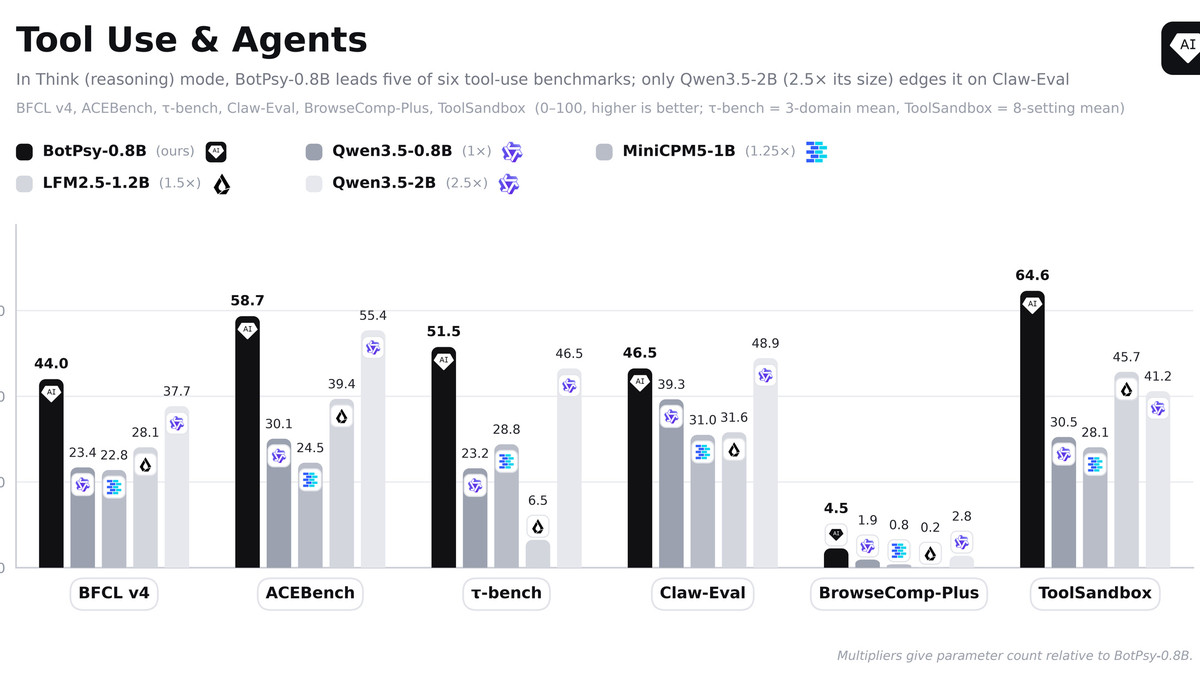
In the company’s own testing, BotPsy used tools more effectively than the base model it was built on. On BFCL v4, which measures the ability to execute tool calls, it scored 44.0 out of 100. The comparison model, Qwen3.5-0.8B-Think, scored 23.4. The company says that among the models it tested at 1.2 billion parameters or fewer, BotPsy came out ahead on all six tool-use benchmarks.
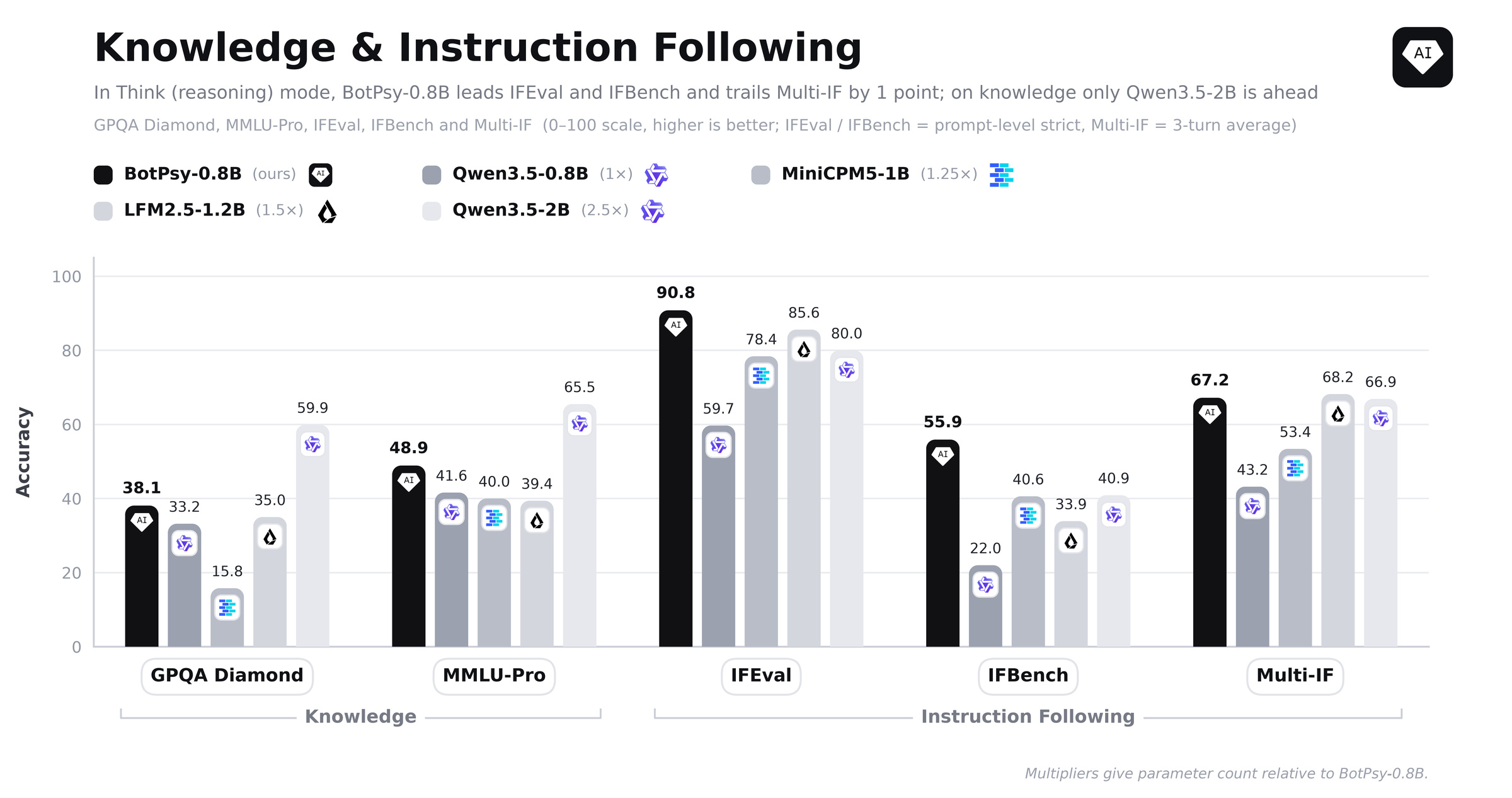
Image: huggingface.co
According to the company, BotPsy also scored higher than Qwen3.5-2B-Think, a model 2.5 times its size, on five of the six benchmarks. On the remaining one, Claw-Eval, BotPsy scored 46.5 against the larger model’s 48.9. The bigger model also came out ahead on general knowledge tests. The company explains that BotPsy is designed to look up facts it does not know by using tools.
Tether AI Research also tested the model’s ability to decline a request when the necessary tool is unavailable. BotPsy scored 86.1 on the BFCL v4 test that evaluates this behavior. The company says its rate of harmful responses also fell in automated safety testing, dropping from 36% for the base model to 21% for BotPsy. Even so, the company notes that BotPsy can still make mistakes and was not designed to be entrusted with consequential decisions.
How you can use it
Tether AI Research says it plans to release the model for research and educational use under the Apache 2.0 license. It is preparing model files at three levels of precision so developers can choose one that fits their runtime environment. The release will also include formats for running the model on a device and connecting it to work tools.
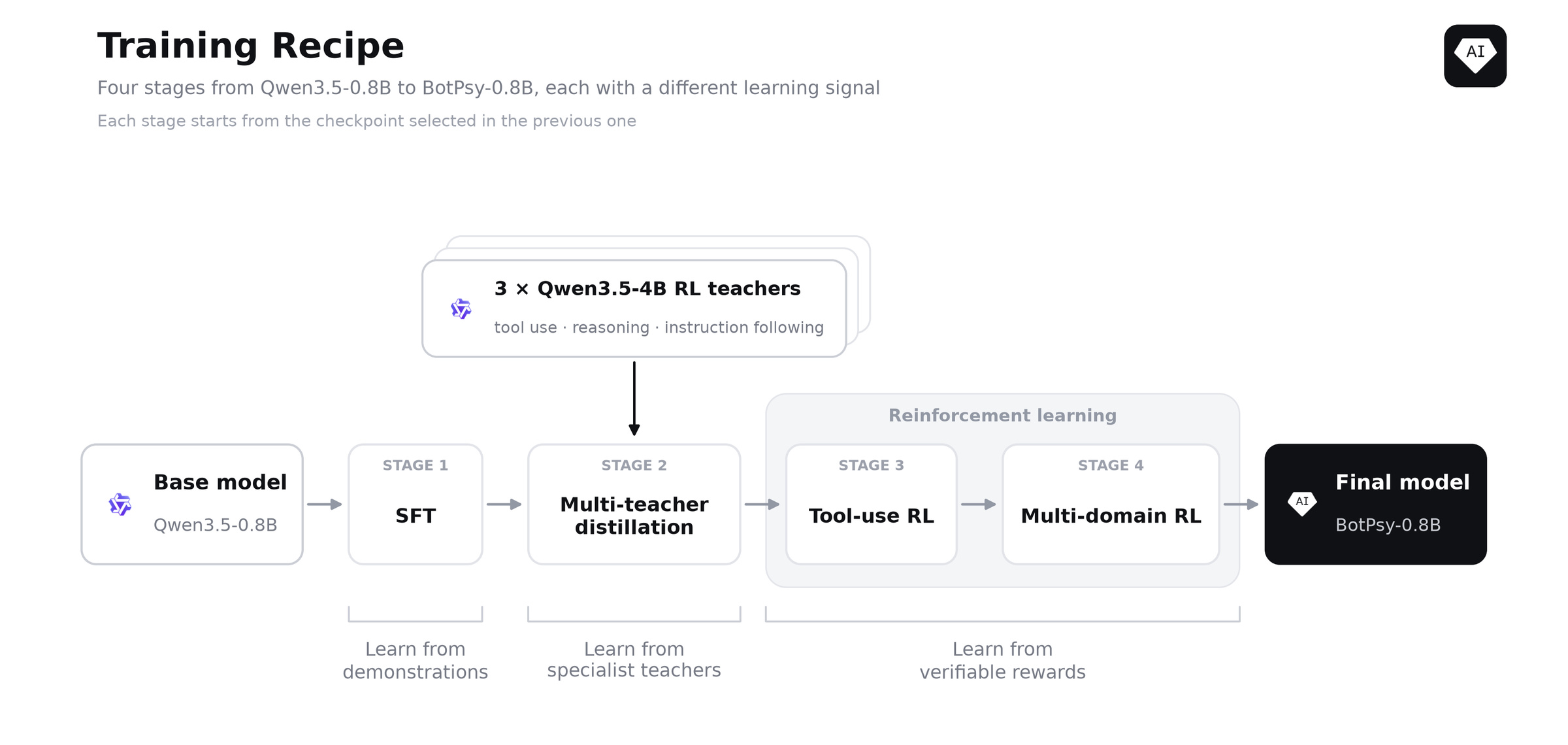
Image: huggingface.co
The company plans to expand the range of hardware and local services BotPsy can connect to. It also intends to develop a feature that lets a smartphone hand off heavier workloads to a home PC or similar machine.
Its ability to follow instructions declined as a conversation went on. In the company’s multilingual instruction-following test, BotPsy scored 84.3 on the first turn but fell to 51.0 by the third.