SK Telecom to Develop System Pairing NVIDIA GPUs with Korean AI Chips
A three-way agreement with NVIDIA and Rebellions will assign prompt processing and answer generation to different chips. The partners will test speed and power efficiency in an AI data center before considering deployment in live services.
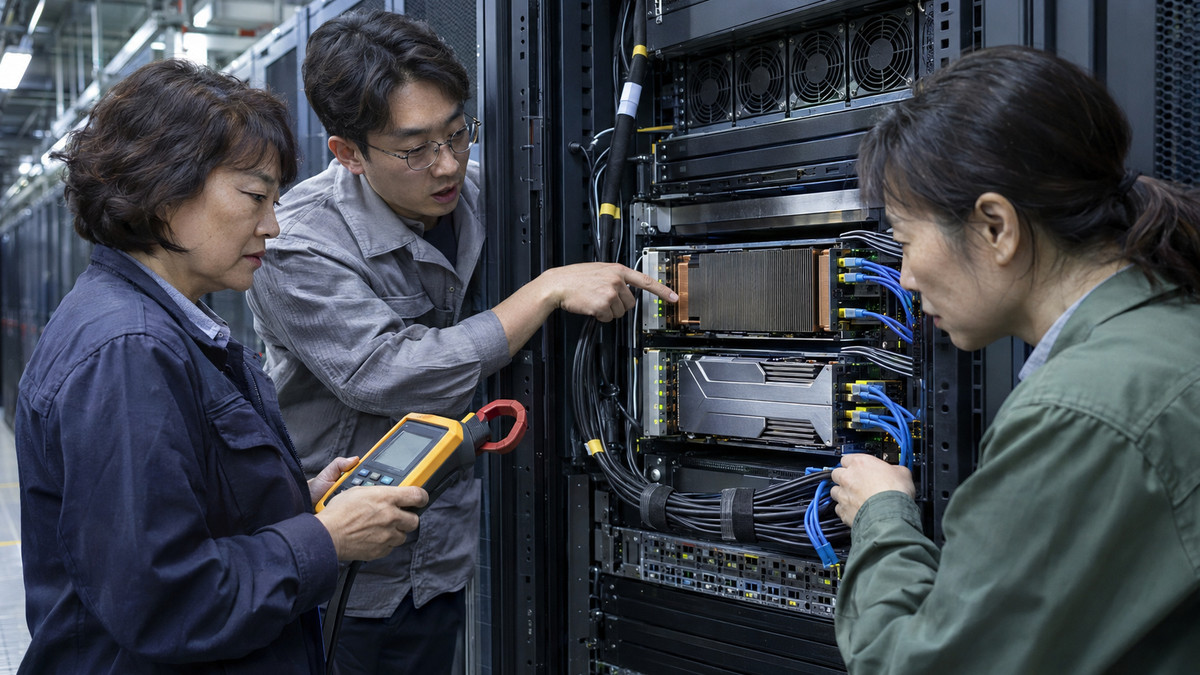
SK Telecom is teaming up with NVIDIA and Rebellions to develop AI hardware that combines chips from both companies in a single system. SK Telecom said the three companies signed a memorandum of understanding at NVIDIA AI Day Seoul, held at COEX in Seoul on November 9. The agreement covers building a system that pairs NVIDIA GPUs with Rebellions AI chips and testing its performance and stability in an AI data center. The collaboration targets sovereign AI: building an AI foundation with Korean technology.
GPUs Process Prompts, Korean Chips Generate Answers
At the heart of the project is “disaggregated inference,” which splits the process of producing an AI answer into two stages and assigns each to a different chip. NVIDIA GPUs analyze the user’s prompt. Rebellions’ dedicated AI processors, known as NPUs, generate the answer one word at a time. The three companies aim to improve response speed and power efficiency by letting each type of chip handle the work it does best.
SK Telecom explained that the two tasks require different capabilities. Analyzing a prompt involves intensive computation, favoring chips with fast processing capabilities, such as GPUs. Generating an answer, meanwhile, depends on retrieving the necessary data from memory quickly. The partners plan to divide the work accordingly and assess the benefits under real operating conditions.
How Korean Chips Will Connect to NVIDIA’s Platform
NVIDIA’s NVLink Fusion technology provides the connection. It extends the high-speed links used to exchange data between NVIDIA GPUs to chips from other companies. The partners will use it to connect Rebel R200, an NPU under development at Rebellions, to NVIDIA’s platform. This will allow the Korean chip and NVIDIA GPUs to share the workload within a single system.
The development effort extends from chip connectivity to server configuration. The partners plan to use MGX, NVIDIA’s server rack design specification, to build an integrated system at the scale of a rack housing multiple servers. Drawing on its experience building and operating AI data centers, SK Telecom will install the system in its own data center. It will test performance and stability there before assessing deployment in live services and the potential for commercialization.
Will the System Power AI Services in Korea?
SK Telecom said it plans to connect this infrastructure to its own AI models and services for the general public. SK Telecom CTO and Head of AI CIC Jung Suk-geun cited the company’s proprietary A.X K2 model and “AI for Everyone,” saying the company would strengthen its sovereign AI capabilities across infrastructure, models and services. The aim is to use the new system as a foundation for AI services in the public and private sectors.
The three companies plan to align the collaboration with the Ministry of Science and ICT’s policies to promote sovereign AI and Korean AI chips. Rebellions CEO Park Sung-hyun emphasized the significance of combining Korean AI chips and models with global technology. Ashish Karandikar, NVIDIA’s vice president of NVLink Fusion, said the company would support the integration of Korean custom chips with NVIDIA’s platform.
The collaboration is still at the development and validation stage. SK Telecom said processing performance, power efficiency and operating costs are becoming increasingly important when running AI services. The questions ahead are how efficiently the two types of chips will work together in an actual data center, and how the results will translate into public- and private-sector services in Korea.