Anthropic Analyzed 200,000 Research Conversations. Data Analysis Was AI's Most Common Use
Researchers leaned on AI mainly for data analysis and writing. Anthropic's take: how much AI accelerates science depends on how much of the work still has to be done by hand, as in the lab.
On November 5, Anthropic published a report analyzing how Claude is used in scientific research. The findings draw on 207,049 research-related conversations across Claude and Claude Code. Researchers mostly handed off data analysis and writing. Idea generation and data collection accounted for a comparatively small share.
The dataset covers conversations on consumer plans between August 2 and September 30, 2026. Of those, 128,914 came from Chat and Cowork, and 78,135 from Claude Code. The report groups Chat and Cowork together as “Claude,” and separately examines use cases from Claude Science.
What researchers delegated
Data analysis topped the list. It accounted for roughly a third of research conversations on Claude and close to half on Claude Code. Yet in an accompanying survey, researchers named idea generation and data collection as the tasks most critical to scientific discovery. What they valued most and what they actually delegated to AI did not line up.
Usage patterns also varied by tool. According to Anthropic, idea generation made up about twice as large a share on Claude Science as on Claude. The company said tools purpose-built for scientific research can help narrow the gap between the research tasks that matter most and how AI is actually used.
Why computer science stood out
Adjusted for the number of researchers in each field, Claude use was especially pronounced in computer science, mathematics, and statistics. Computer science accounts for 4.3% of researchers worldwide but 32.7% of research conversations on Claude Code. AI and machine learning also showed usage shares above their share of researchers. Use was relatively lower in chemistry, which involves heavy lab work, and in medicine, which involves working with patients.
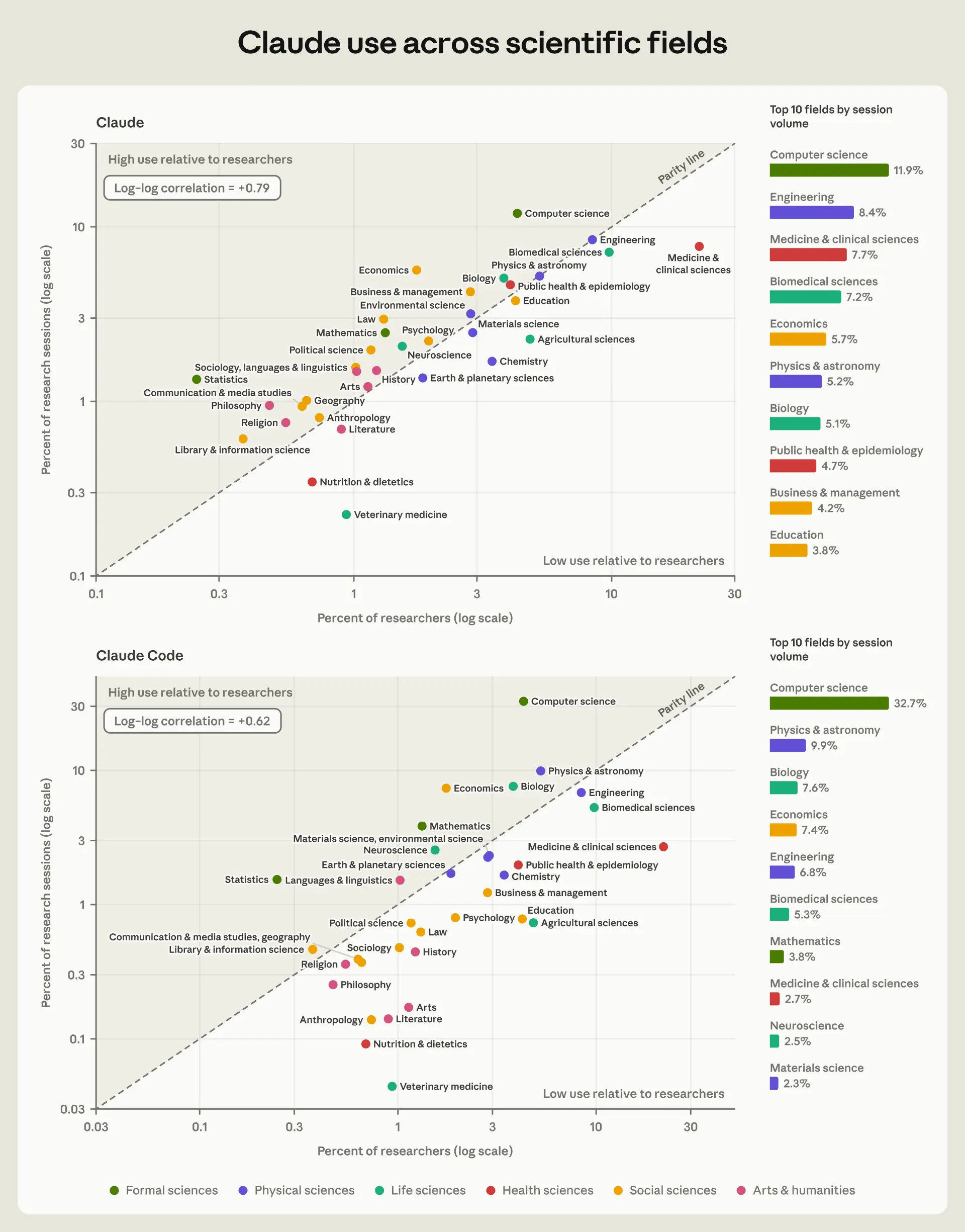
Image: anthropic.com
Anthropic also built an index scoring how well AI can perform each research task. For tasks in the top 20% by score, usage ran two to four times as high as researchers’ time allocation would predict. In the bottom 20%, which includes many tasks requiring hands-on physical work, use was very low. The company read this as researchers steering AI toward the things it does well.
How much could research output grow
Anthropic’s modeling estimates that widespread adoption of current AI capabilities could as much as double research output in some fields. Assuming AI takes on every research task except the hands-on physical work such as running experiments, output in computer science and statistics rose to as much as 15 times its baseline level. In chemistry and biology, experimental constraints held the increase to three or four times the baseline.
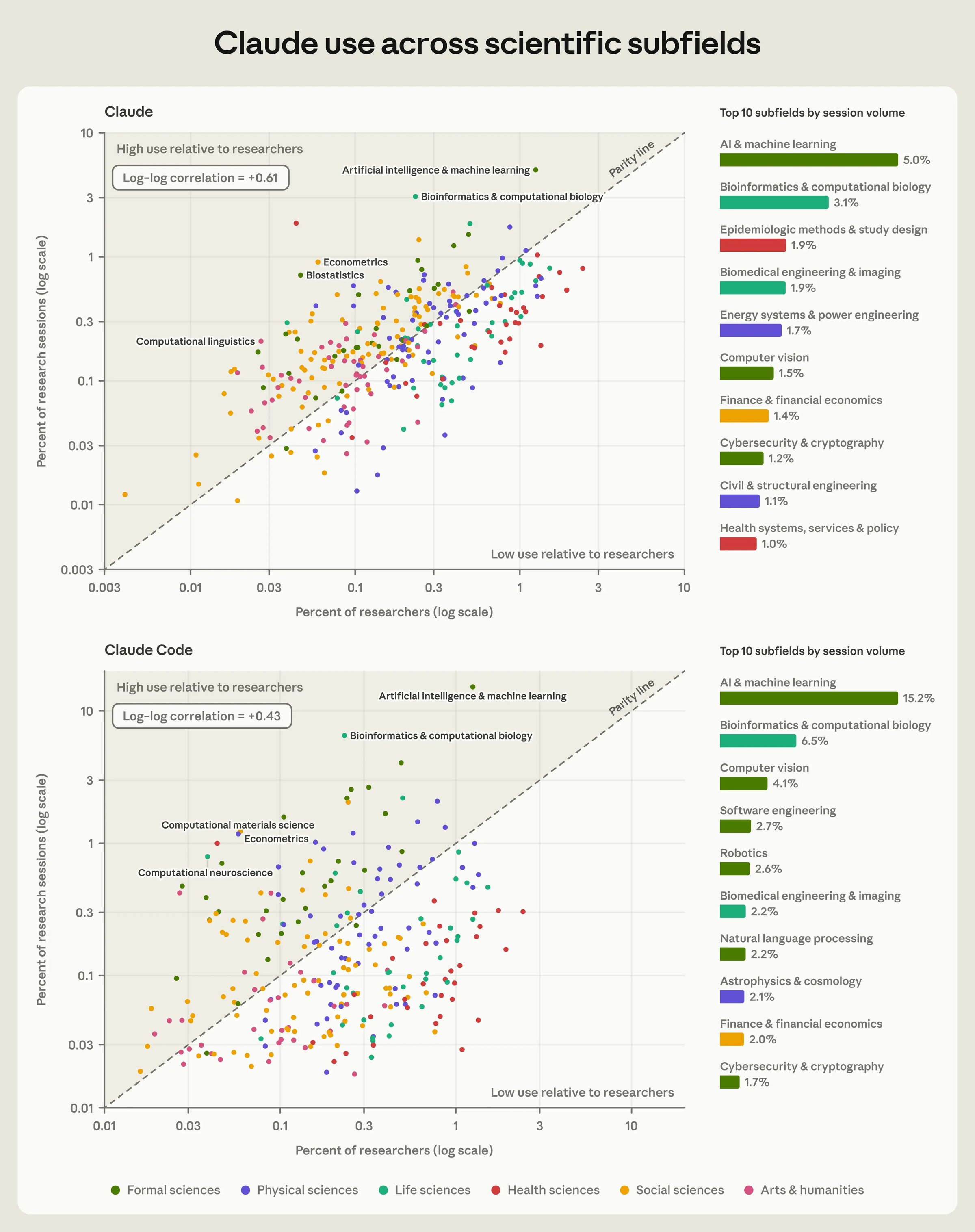
Image: anthropic.com
How the conversation data was handled
The research team said it analyzed conversations in a privacy-preserving way. AI labeled each conversation with a research field and task type, and the team retained and analyzed only those classification values. Research data, hypotheses, and unpublished paper content were not separately extracted or stored. Results were released only in aggregate units covering a minimum number of accounts, the company said.
Field labels alone reveal little about how much AI is actually used in research. What matters more is which tasks get handed off. The thing to watch next is whether AI’s usefulness grows in idea generation and data collection too. How much it can reduce the work that only people can do by hand, such as experiments, was also flagged as a key variable in how fast research moves.