Google Unveils Smartwatch AI That Flags Hypertension Without a Cuff
No arm-cuff calibration required: the system judges the likelihood of high blood pressure from several days of sensor data plus the user's height. Early screening performance was tested on 196 people in the US.
Google Research on November 5 unveiled a study describing an AI system that uses the sensors in an ordinary smartwatch to spot signs of high blood pressure. The system, called AI-PPG-ACC-HTN, analyzes the body signals a watch collects over several days and turns them into a score representing the likelihood of hypertension. In the study, published in Nature, Google said it validated the system’s performance against ambulatory blood pressure monitoring, a test that measures blood pressure over 24 hours as a person goes about daily life.
The problem Google is targeting is that a great many people have high blood pressure without knowing it. According to Google, more than a billion people worldwide have hypertension, and more than half of adults with the condition are unaware of it. Because clear symptoms are rare, the company notes, the condition is often discovered during incidental screening.
What it measures instead of blood pressure numbers
The system does not try to predict systolic and diastolic readings at a given moment. Instead, it gathers signals across multiple days to judge whether a person’s blood pressure is persistently elevated. Google explained that most commercial wearables available today need to be calibrated periodically against an arm cuff. The system in this study was designed to look for signs of hypertension without that step.
Image: research.google
The AI looks at two signals: the optical pulse signal read from the wrist and the accelerometer signal that captures movement, analyzed together. The researchers trained the model on 492,347 hours of sensor data from 2,109 consenting participants. The model first extracts physiological features from short segments of signal, then aggregates them across several days, an approach meant to reduce the influence of sudden movement or temperature changes. The user’s height is added to that, and the model computes a hypertension likelihood score.
The clinical evaluation involved 196 participants at five sites in the United States. Participants had no known cardiovascular disease and were not taking blood pressure medication. The researchers evaluated two distinct scenarios: an initial clinic screening to flag possible hypertension, and a follow-up confirmation after an elevated first reading. Both were compared against 24-hour ambulatory blood pressure results.
Did it outperform the clinic exam?
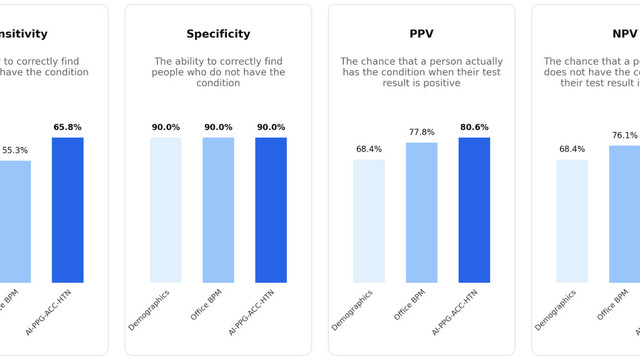
In the initial screening scenario, the smartwatch identified 65.8% of people who actually had hypertension. It correctly classified 90.0% of people without hypertension as normal. Among those the watch flagged as hypertensive, 80.6% truly had the condition. In the same scenario, a first in-clinic measurement identified 55.3% of people with hypertension, and 77.8% of those it flagged were true cases.
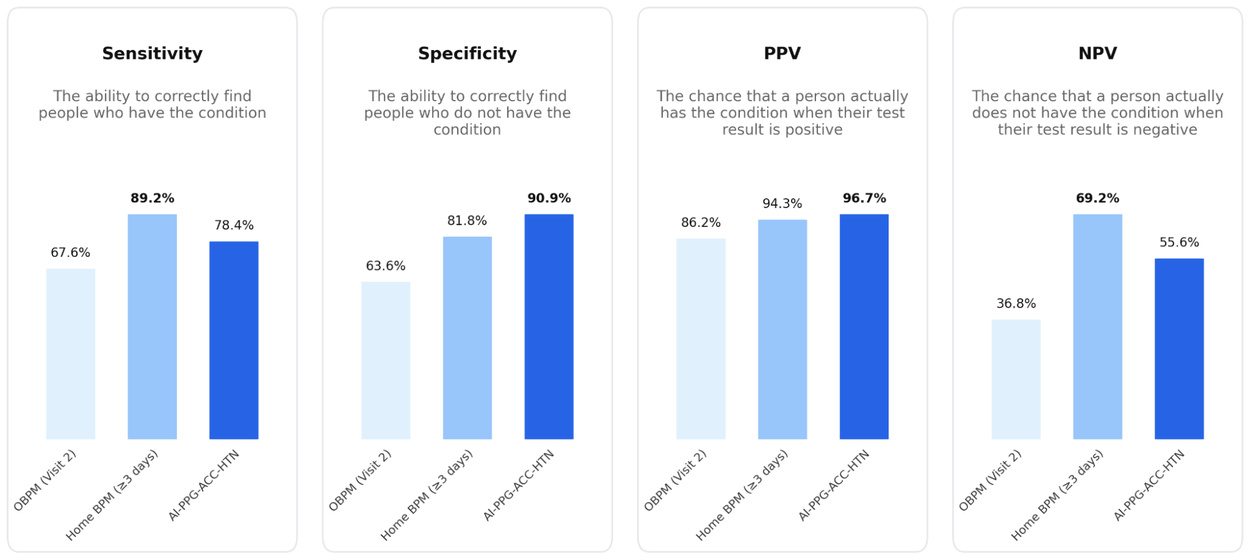
Image: research.google
The researchers also looked separately at the 48 participants whose first clinic reading was elevated. In that group, the smartwatch identified 78.4% of those who actually had hypertension. A repeat clinic measurement caught 67.6%, and multi-day self-measurement at home caught 89.2%. Conversely, the share of non-hypertensive people correctly classified as normal was 90.9% for the smartwatch, 63.6% for the repeat clinic measurement, and 81.8% for home measurement. Each method, in other words, had its own strengths in detecting hypertension and in correctly identifying people without it.
Google described the work as an early feasibility study. The company said smartwatch screening is not meant to replace a standard blood pressure cuff or a separate confirmatory test. The intended role is to help people showing warning signs get a proper clinical evaluation, broadening the opportunities for testing through a device people already wear every day. Google said the findings informed the development of the blood pressure trends feature in the Google Health app.