SK Telecom Adds a User-Perceived Quality Metric for the Busan Fireworks Festival
At a venue drawing more than 1.2 million people, the carrier will track usage quality separately for services like web browsing and video. AI will manage demand and congestion, backed by mobile base stations and on-site crews.
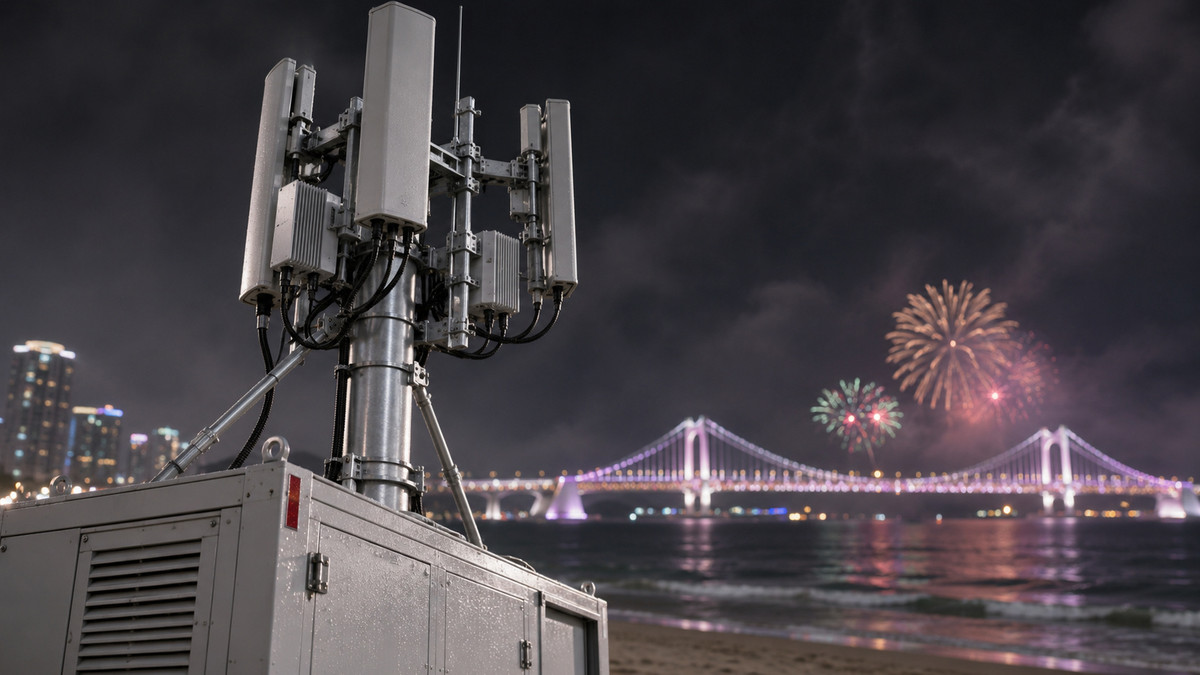
SK Telecom said on November 5 that it has drawn up a special network management plan ahead of the 21st Busan Fireworks Festival, which takes place on November 7. The carrier is adding a metric it calls the “perceived quality satisfaction rate” to its existing AI-driven operations system, so that it can track the quality spectators actually experience while using a service. It is also bringing in additional mobile base stations and temporary repeaters, and deploying roughly 100 staff assigned to emergency duty.
The festival runs from 1 p.m. to 8 p.m. on November 7 around Gwangalli Beach in Busan. SK Telecom expects this year’s crowd to exceed 1.2 million people. By the company’s own count, attendance was 1.03 million in 2024 and 1.17 million last year.
Why web and video are measured separately
The newly added perceived quality satisfaction rate is the proportion of service use in which quality stays at or above a set threshold. SK Telecom explained that it is a measure of whether data flows without dropping or lagging and whether screens load smoothly. In other words, the company has layered a measure of how consistent quality is during use on top of its previous approach, which centered on peak speeds.
Monitoring is broken into four categories: web, social media, workplace collaboration, and high-definition video. The company says data moves differently for each type of service, so quality differences have to be examined separately. That means a spectator’s experience opening a web page or watching a video now feeds into the standards by which the network is managed.
Where the AI comes in
The first use is finding places where quality has degraded. SK Telecom said it divides an area into a grid and analyzes quality by location, then combines that with AI-analyzed location data to assess quality by situation as well. This approach, the company said, makes it possible to distinguish whether a user is in transit on the KTX high-speed rail or the subway, or is at home. For this festival, the venue’s characteristics, the expected crowd size, and the type of service are all taken into account together.
AI is also used to prepare network capacity in advance and to respond to congestion during the event. A-One, the company’s wireless network operations system, calculates the capacity needed ahead of time based on expected attendance and past traffic volumes. A system called Spider, which watches over the core of the network, monitors for anomalies in real time. On the day of the event, SK Telecom plans to apply AI-based controls that distribute network load in real time.
What is being added on the ground
Equipment reinforcement is being carried out at Gwangalli Beach and Marine City. Mobile base stations and temporary repeaters are being added to prepare for traffic concentrating in a single spot. Nearby areas where spectators gather, such as Yongho Bay and Igidae, are also targeted for intensive management. SK Telecom plans to adjust coverage areas in advance and check on-site quality in real time.
Emergency duty starts on the morning of November 7 and continues until the crowds disperse. About 100 people from SK Telecom, SK O&S, and partner companies will take part, and they will also handle safety management around telecom facilities. The plan sets whether a service keeps running without interruption, not just raw connection speed, as a management standard. What remains to be seen, once the event is over, is how much this new metric actually changed the quality spectators experienced.