A 65MB AI That Reads Text Aloud Offline, and It's Free for Commercial Use in English
A model of roughly 65 to 75MB reads your text aloud without sending it to a server. The English model is free even for commercial products, while Korean is available only through custom training for partners, the development team says.
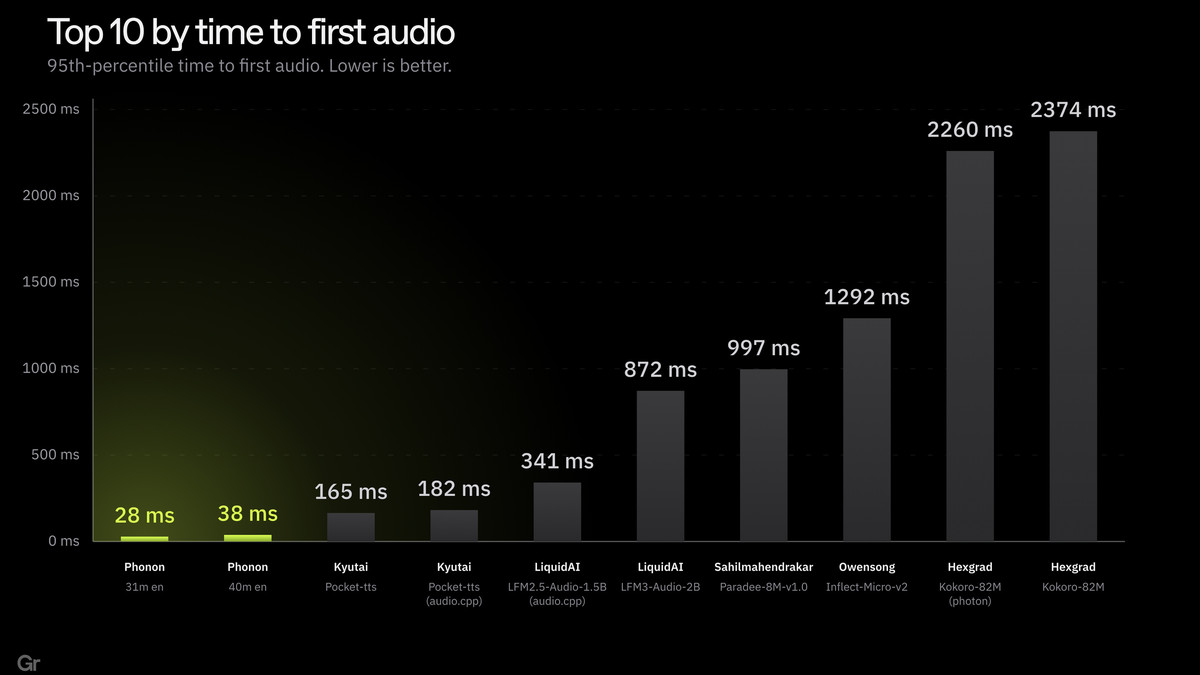
The team behind Phonon, an AI model that turns text into speech, published results from its first two weeks of availability along with performance benchmarks on November 5. Phonon runs on a user’s own device, with no server or internet connection required. According to the team, the text you feed it never leaves the device. Downloads passed 200,000 in the first two weeks after launch.
A 65MB model: what hardware can run it?
Phonon runs on smartphones, laptops, small single-board computers, and in web browsers. It comes in two sizes, roughly 65MB and 75MB. Between them, the two models can read English, French, German, Spanish, and Portuguese. The team says that over the six months since its April announcement, feedback from partners and early users helped it shrink the model while expanding language coverage and custom voice features.
Demos were used to show that voice guidance keeps working even when the connection drops. On an Apple Watch with Wi-Fi turned off, the model walked a user through the steps of brewing coffee. On an iPhone with no cellular signal, it counted out exercise reps with words of encouragement. The team also showed off a case where game voices were generated directly on the user’s computer, and another that read a book one page at a time.
More than 100 preset voices are included. Users can also build their own voice in Gradium Studio, either by cloning a voice from a short recording made with the speaker’s consent, or by describing the characteristics they want in text. Once a voice is finished, the file can be downloaded, loaded into Phonon, and run on-device. The team says the model also handles tricky-to-read strings such as phone numbers, dates, and code.
Pronunciation accuracy, measured against models 100 times larger
The team reported taking first place for pronunciation intelligibility in German and Spanish on Hugging Face’s Open TTS Leaderboard. It says Phonon placed in the top three across every language evaluated, in a field that included models up to 100 times its size. Pronunciation intelligibility measures how accurately the generated speech can be understood at the word level.
Image: huggingface.co
The team also highlighted how quickly the first audio arrives. In a test that generated speech on a CPU and streamed it out immediately, Phonon led the field on time-to-first-audio, according to the team. The leaderboard compares pronunciation intelligibility, speed, naturalness, and other measures across 23 languages. It also lets users listen to samples from multiple models and vote for the one they prefer.
How much of it is free?
Phonon 31m, the English-only model, is released under the Apache 2.0 license and can be used free of charge even in commercial products. Phonon 40m, which covers five languages, carries a non-commercial license. The team says commercial use of 40m is priced by number of users rather than by volume of audio generated.
Image: huggingface.co
Will it read Korean?
Korean is not among the five languages supported out of the box. The team says Korean, Arabic, and Japanese can be trained into custom models built for partners. Phonon makes sense for products that need voice features without a network connection and want input text to stay on the device. Anyone weighing a deployment in Korea will want to check the quality of a custom Korean model, the terms attached to it, and response times on the devices they actually plan to use.