Dharma-AI Releases an AI That Extracts Only the Fields You Need From Invoice Photos
Dharma Field Extractor reads invoices and ID cards, picks out just the information you specify, and hands it to business systems. In the company's own benchmark it scored higher than general-purpose AI models while costing less to run.
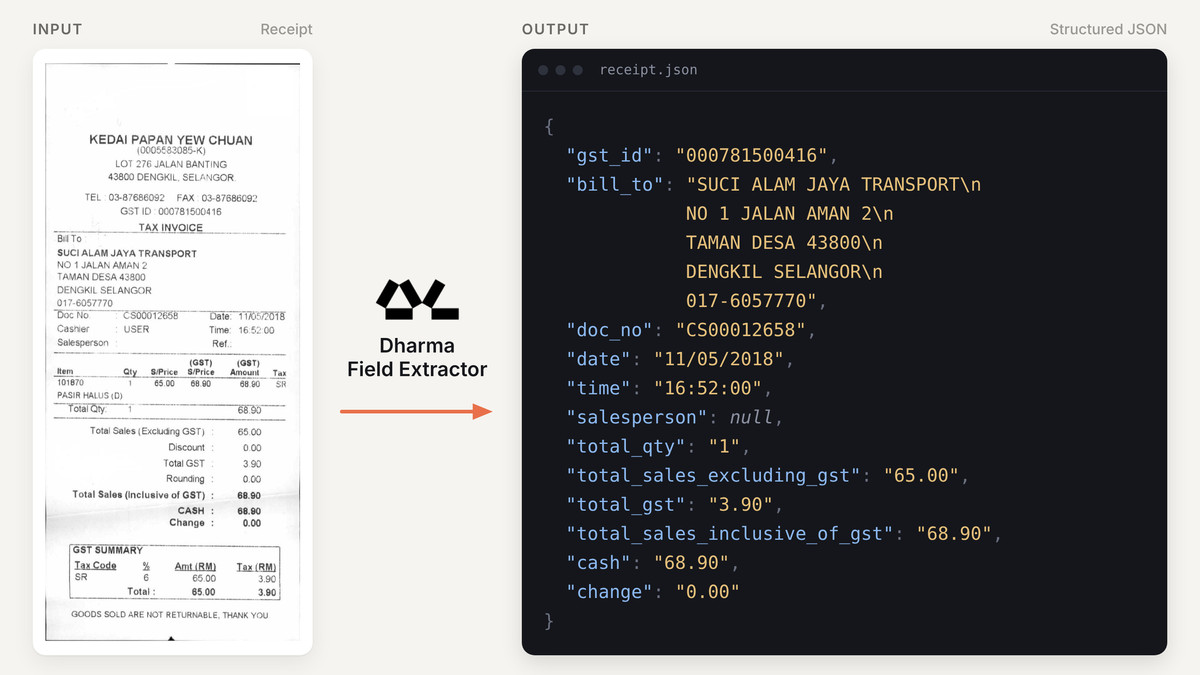
On November 4, Dharma-AI released Dharma Field Extractor, a model that pulls only the fields you need out of document photos. Given an invoice image, it picks out business-relevant information such as the supplier, the payment due date and the total. The output comes back as JSON, a data format other programs can consume directly. The model is about 2 billion parameters in size.
From reading documents to extracting fields: what changed
The difference from conventional document recognition is that this model organizes what it reads into business fields. DharmaOCR-LITE, which Dharma-AI released this past April, specialized in reading the text and layout of a document. But to load that output into a database, someone still has to work out which value is a date and which number is the total. The new model is designed to handle that step too.
There are two ways to use it. If you do not specify any fields, it examines the document’s layout and context and finds tables or name-value pairs on its own. If you already know which fields you need, you can declare the field names and value types in advance. In that case, the company says, the model uses exactly the names you gave it and does not add extra fields. If you ask for a value the document does not contain, Dharma-AI says the model does not invent content but returns null, a marker meaning there is no value.
For invoices, it groups per-item quantities and amounts into a list; for ID cards, it extracts the information needed for employee records. Another use case the company presented is passing a patient’s name and test type from a lab requisition form into a scheduling system. According to the company, the same model can be used without separate additional training for each document type.
How the scores and costs were measured
The company published results from 1,638 test runs, covering 546 documents processed under three different request styles. It tested asking for all fields, asking for only some of the fields actually present, and asking for fields the document does not contain. The score reflects whether the model identified the right fields and their positions within tables, how closely the extracted values matched the ground truth, and whether the output was valid JSON.

Image: huggingface.co
Dharma Field Extractor scored 0.834 on this benchmark. Among the four general-purpose AI models tested alongside it, Claude Opus 5 scored 0.816 and GPT-5.6 Luna scored 0.741. The company says its model scored higher than all four. The new model is built on DharmaOCR-LITE v1.1 with 43,384 additional training examples. Training relied mainly on English and Portuguese documents, with some documents in other European and Asian languages included as well.
According to the company, the cost of running it came to roughly 1/6 to 1/147 of what the comparison models cost. The two sets of figures, however, were calculated on different bases. For the general-purpose models, each vendor’s published pricing was applied to actual per-page usage. For Dharma Field Extractor, the figure assumes self-hosted deployment, calculated at $2.24 per hour for a single L40S GPU. The company notes that this figure is not a sales price. Actual costs will vary with hardware, throughput and the response speed you require.
How you would use it at work
What this model targets is the job of reading a document and then moving the needed content into fixed slots in a business system. Dharma-AI also pointed to a demo feature that lets users try it on their own documents. Companies weighing adoption would do well to check whether it extracts the right values from the invoices and forms they actually use, whether it leaves fields absent from the document blank, and whether the cost advantage holds up under their own operating conditions.
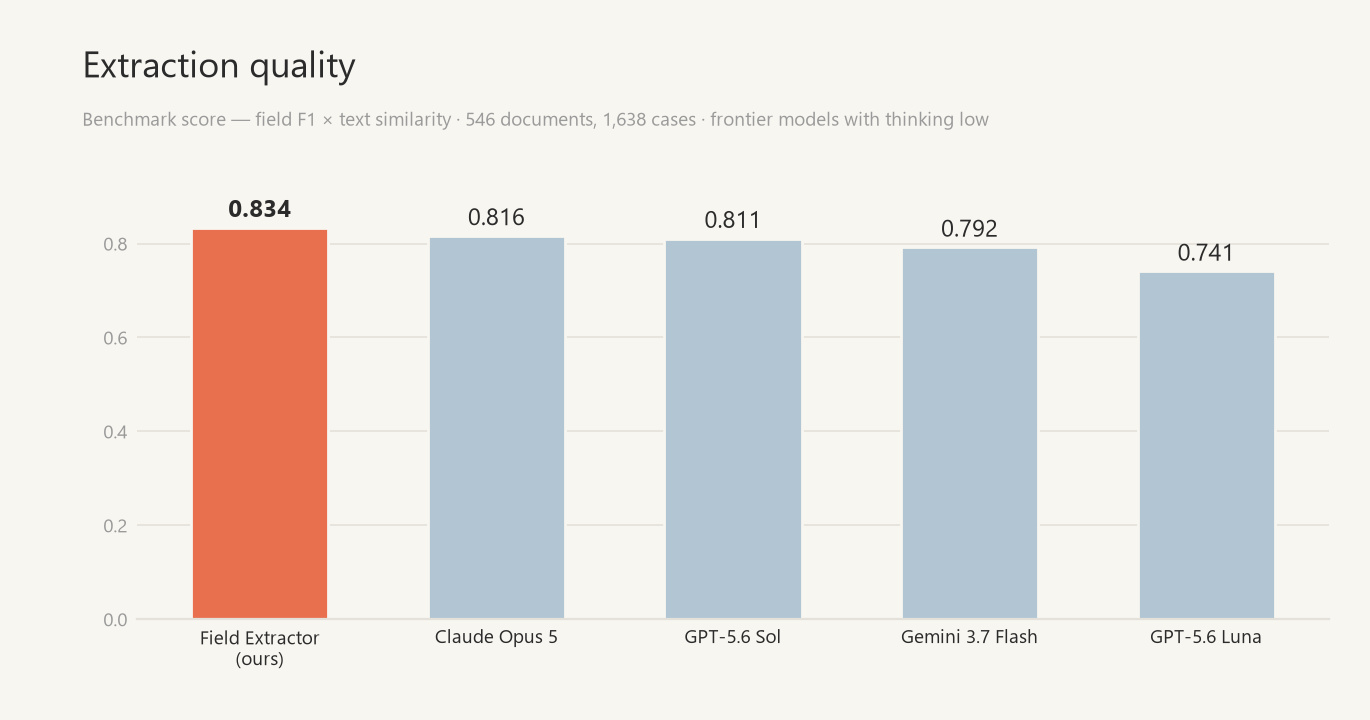
Image: huggingface.co