Where Does "Healthy Food" End? Google Unveils AI That Helps Classify Ambiguous Images
The targets are concepts like "healthy food," where there is no single right answer. The system shows you ambiguous images, collects your opinions, and lets the AI revise its classification criteria. Google says classification performance and the consistency of judgments both improved across 18 experimental sessions with participants.

Google Research unveiled Agile Deliberation on November 4 (local time), a research method designed to help classify images according to subjective criteria. It targets concepts where no single right answer exists, such as “healthy food” or “inspiring art.” A person judges borderline cases, and the AI takes that input to refine the classification criteria. Google also released the related code and algorithms as open source.
Where does “healthy food” end?
Conventional approaches that train AI by attaching labels to images assume the person already knows the classification criteria clearly. That works well for sharply defined targets like stop signs. But what counts as healthy food shifts with culture and individual belief. Google’s researchers focused on the process by which people sharpen their own criteria while looking at real examples.
Agile Deliberation first asks users to break a broad concept into smaller categories. For healthy food, that might include salads, grain bowls, and lean protein dishes. At the same time, users decide what to exclude, such as processed foods or raw, uncooked ingredients. Once the inclusions and exclusions are sorted out, users look at actual images and adjust their criteria.
How are the ambiguous photos used?
In the next stage, an AI that understands text and images together finds and surfaces photos that are hard to judge. A fruit smoothie, for instance, could be a healthy drink made with fresh fruit, or a sugar-heavy processed product. Looking at cases like this, users discover conditions they had not thought of at the outset. And then they revise the classification rules they want.
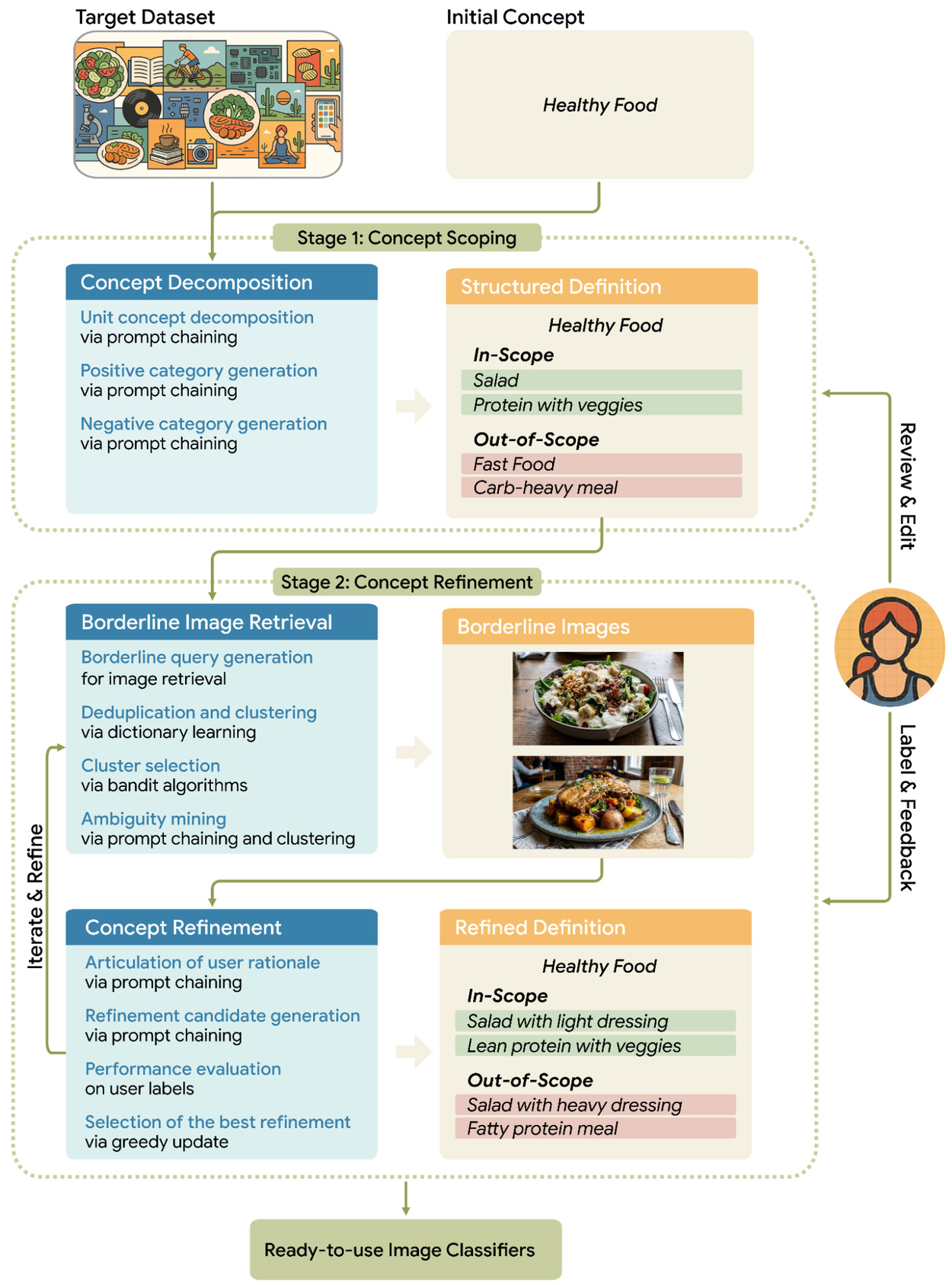
Image: research.google
At this point, users do not themselves edit the prompt — the instruction text given to the AI. They simply look at the images and convey their own opinions. The system takes those opinions and automatically rewrites the instructions, applying them to the classification. Google explained that unlike conventional approaches that select examples to reduce the AI’s uncertainty, this method seeks out and presents images that sit on a semantic boundary. That, Google says, is what allows people to clarify judgment criteria that had been vague even to themselves.
What did the people who tried it say?
Google ran a user study with a working prototype. There were 18 live sessions with participants, each lasting one hour and 30 minutes. Participants used Agile Deliberation and three comparison methods in a randomized order. A pre-labeled batch of images alone makes it hard to see how a user’s thinking changes. For that reason, the researchers said, they chose to observe people actually using the tool.
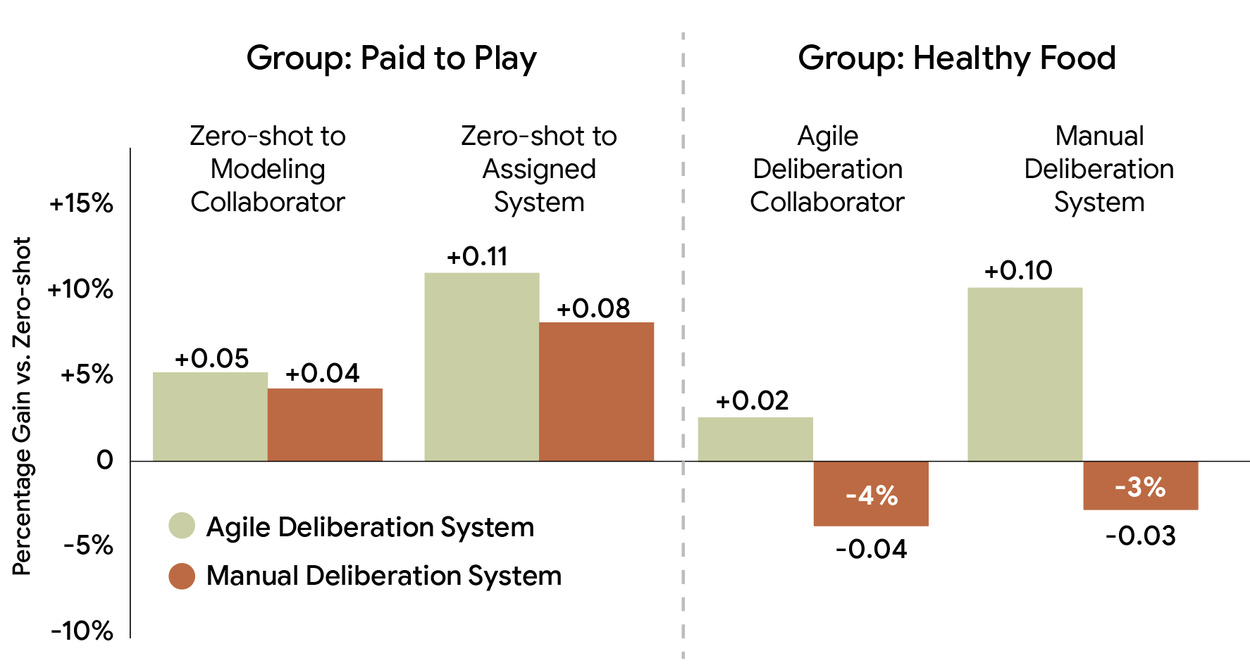
Image: research.google
According to Google, participants who went through this process made more consistent classification judgments over time. The resulting classification models also outperformed all three comparison methods. The gains were especially large on images where subjective judgment is difficult, Google explained. Participants reported less stress, frustration, and mental fatigue than when editing the instructions themselves. Google said every participant preferred Agile Deliberation over editing the instructions directly.
The researchers also pointed to a hands-on demo where you can work through the “healthy food” example yourself. The application areas Google suggested include content moderation, curating digital works, and classifying scientific images. Whether intent is captured just as well when the criteria are described in Korean, and whether the same effect holds up in real work settings, are questions to watch. Ultimately, what this research is after is reducing the burden on users to produce a finished set of rules from the very start.