Images in 0.3 Seconds, With More Accurate Text: Inside the New IDM Training Method
Researchers at Inclusion AI have released a training technique that renders text inside images more accurately with little computation. The image generation code is available, but the trained model weights are still marked "coming soon."
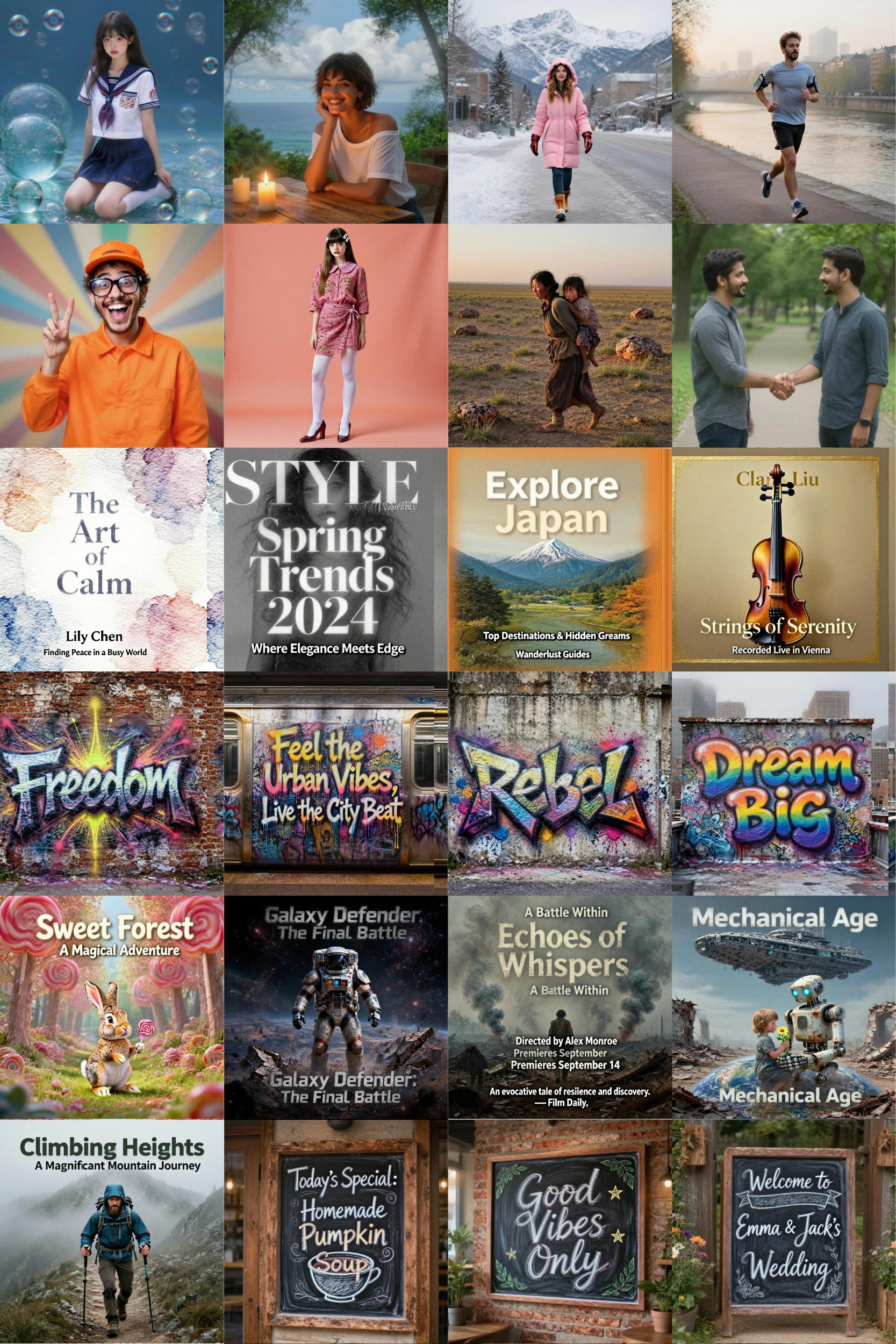
Researchers affiliated with Inclusion AI, along with several universities and research institutes, have published a new technique for training image generation models called Intrinsic Distribution Matching (IDM). The work targets a specific problem: how to improve the accuracy of models that generate an image in just one or two computation steps. According to the team, a model built on Z-Image produced an image in 0.30 seconds using two steps. Scores also improved on tests that measure how well English and Chinese text is rendered inside the generated image.
An image in 0.3 seconds, but is the text correct?
Models that generate images in very few steps have fewer chances to refine the result. Everything the user asked for, down to the fine details, has to be captured in that short process. IDM tackles the problem at the training stage. To gauge how accurately text lands in the image, the researchers ran tests that require inserting long passages of text.
The experiments covered Z-Image-Turbo, a 6-billion-parameter model, and Qwen-Image, a 20-billion-parameter model. Under a two-step setting, the Z-Image model trained with IDM scored 94.25% on Chinese and 90.20% on English in the LongText-Bench text test. The researchers say those are the highest scores among the methods compared in the paper at the same step count. The 0.30-second figure was measured by the team directly on a single graphics card (an A100).
What IDM adds to existing training methods
Distribution matching distillation (DMD), the established approach, teaches a model so that the overall statistical properties of the images it generates move closer to those of reference images. Earlier work attached a separate neural network to estimate those image properties. IDM, following prior research such as TwinFlow and APEX, instead uses signals already present inside the image generation model itself. On top of that, it adds a constraint that aligns the mean and the spread of the generated image’s feature values with the reference.
The reference values come from a copy of the model that accumulates and reflects the model’s own state over time. The team says this removes the need to bolt on an external feature extractor. The computation happens only during training, not when images are actually being generated. Compared against a DMD control group trained under identical conditions, IDM came out ahead on all five evaluation metrics. However, APEX scored higher than IDM on DPG-Bench.
Can you use it right now?
What is available today is the paper and the code for generating images. As of October 30, the official repository lists the trained model weights as “coming soon.” The code alone makes it difficult to reproduce the exact IDM results reported in the paper. The code is released under the Apache 2.0 license, and the model weights will carry a separate license later.
What about Korean text? The official materials cover only English and Chinese in their text tests and examples. There is no information on Korean text rendering performance or on any plans for a release in Korea.
This research focuses on capturing the specific details a user asks for more accurately within a very short generation window. For anyone who wants text inside their images, text accuracy is worth examining alongside raw speed. Whether people can try it in practice will depend on the release of the model weights, the terms of use, and Korean-language test results.