SK Telecom Drops 10,000 Seed Balls by Drone on Steep, Hard-to-Reach Andong Slopes
10,000 trees have gone into 4.4 hectares of wildfire-damaged land in Andong, with another 10,000 seed balls dropped by drone. AI analyzed terrain and vegetation to widen the restoration area and track how the trees are doing.
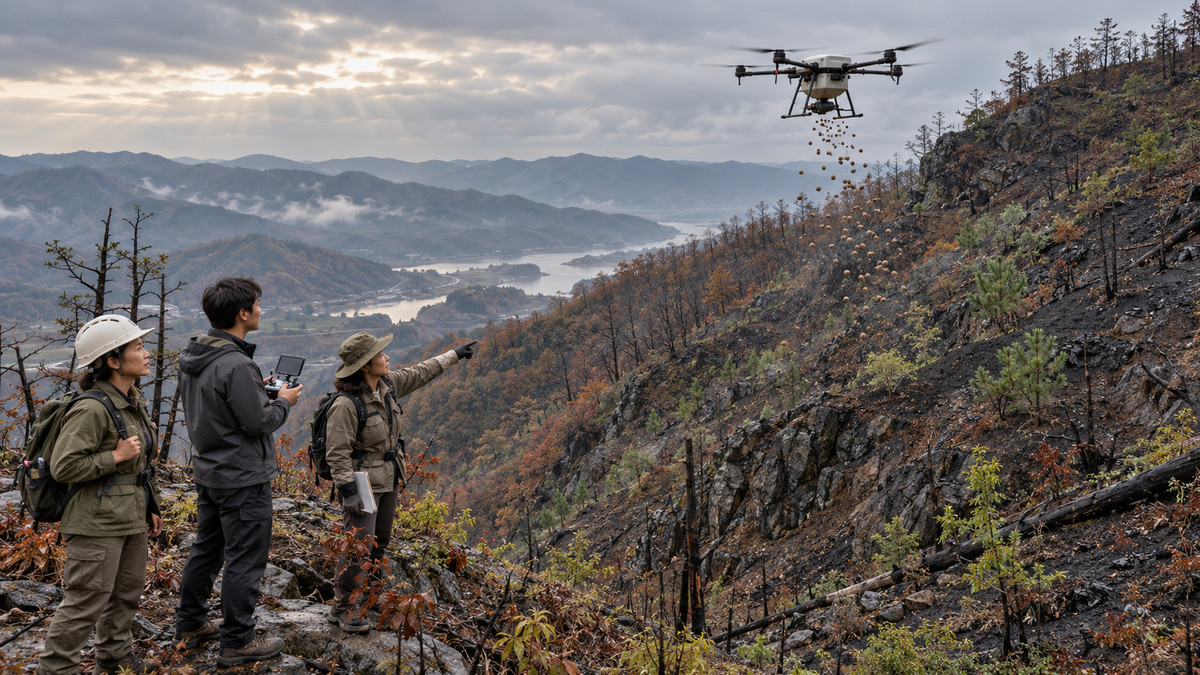
SK Telecom has released an update on its effort to restore wildfire-damaged land in Andong, a city in North Gyeongsang Province, using AI and drones, along with its plans going forward. SK Telecom said it held a seminar on October 29 together with Yuhan-Kimberly, the nonprofit Forest for Peace, and Inverlab, a natural-environment technology startup. The technology was used to extend restoration into steep slopes too difficult for people to walk into, and to monitor how the planted trees and surrounding vegetation are growing.
The seminar presented progress on the “Andong Forest for Peace” project, a joint undertaking by the four companies and organizations. Since March, SK Telecom and Yuhan-Kimberly, working with Forest for Peace, have planted 10,000 trees across 4.4 hectares (ha) of wildfire-damaged land. The species planted include Sargent cherry, Japanese raisin tree, linden, painted maple, and Japanese snowbell.
How do you plant on steep slopes that are hard to reach?
In hard-to-reach areas, seed balls were dropped by drone. SK Telecom explained that, together with Inverlab, it had scattered 10,000 seed balls across an area that includes steep slopes. A seed ball is a sphere made by mixing seeds from plants that grow in the area with soil and nutrients. The aim was to create conditions where trees can grow well.
AI was used to analyze the environment of the land slated for restoration, examining slope and terrain shape, water channels, and how much sunlight reaches the ground. SK Telecom said it used this kind of spatial analysis technology along with drones to extend the reach of forest restoration into areas people cannot easily access. Environmental analysis of the surroundings and drone seeding were added on top of the conventional work of planting trees by hand.
Who watches over the site after planting?
AI and drones were also used for management after the seeding. SK Telecom said it observed how vegetation in the wildfire-damaged area was changing and the condition of the growing trees. It also identified areas where more trees need to be planted and where plants that disrupt the ecosystem have spread.
The four companies and organizations plan to keep tracking changes in plant growth. Their stated approach is to build out a forest management system based on quantitative data recorded from those observations.
This restoration project grew out of a memorandum of understanding SK Telecom and Yuhan-Kimberly signed in September of last year. Beyond creating forests on wildfire-damaged land, the two companies have worked together on resource circulation and biodiversity conservation. This past September they ran an e-waste recycling campaign and planted trees for a honeybee forest in Yeoncheon, Gyeonggi Province, and on October 23 they joined a project to restore trees and green space in the Changgyeonggung area, around the royal palace in Seoul.
Eom Jong-hwan, head of SK Telecom’s sustainability management office, said the company would combine its AI capabilities with Yuhan-Kimberly’s experience in forestry to pursue restoration over the long term. The Andong project is a case of applying AI to environmental analysis and post-restoration management at a wildfire site in South Korea. The key question now is how clearly the tracking and data management to come will document the forest’s actual recovery.