From Assisting Employees to Coordinating Between Management and Staff: Three AI Roles in an OpenAI Essay
An essay published on OpenAI's website sorts AI's possible place inside companies into three roles. The authors say the open question is how to measure whether AI can actually handle management work.

On October 28 local time, OpenAI published an essay on its website about AI and the changing shape of the firm. Titled “The future of the firm,” it was written by Hemanth Asirvatham and Elliott Mokski. The two authors examine three places AI could occupy inside a company: helping an individual employee with their work, becoming a member of a team, and coordinating between management and staff.
The authors present each of the three as a single illustrative scenario. They also note that the views in the piece are not OpenAI’s official position.
Who will AI work with?
The first scenario is one in which each employee uses AI to take on a wider range of work. What changes here is the scope of what a single employee handles. The authors start from the relationship between an employee and AI, then discuss how using AI could affect a company’s work processes and an employee’s autonomy.

Image: OpenAI
The second is AI handling a team’s work alongside people. The discussion widens from assisting one employee to taking on the work of an entire team. Where the first scenario focused on the scope of each individual’s job, this one invites you to think about how a mixed team of humans and AI would be put together.
The third is AI working between management and staff. In this position, the authors explain, AI could help with gathering information, offering advice, and coordinating. That goes a step beyond handling the work of an individual employee or a team, extending to a role that connects different vantage points within the organization.
Can management work be handed over too?
The authors note that it is still not well understood how much AI models can actually accomplish in management work. They also point out that benchmarks for measuring executive-level coordination ability are scarce.
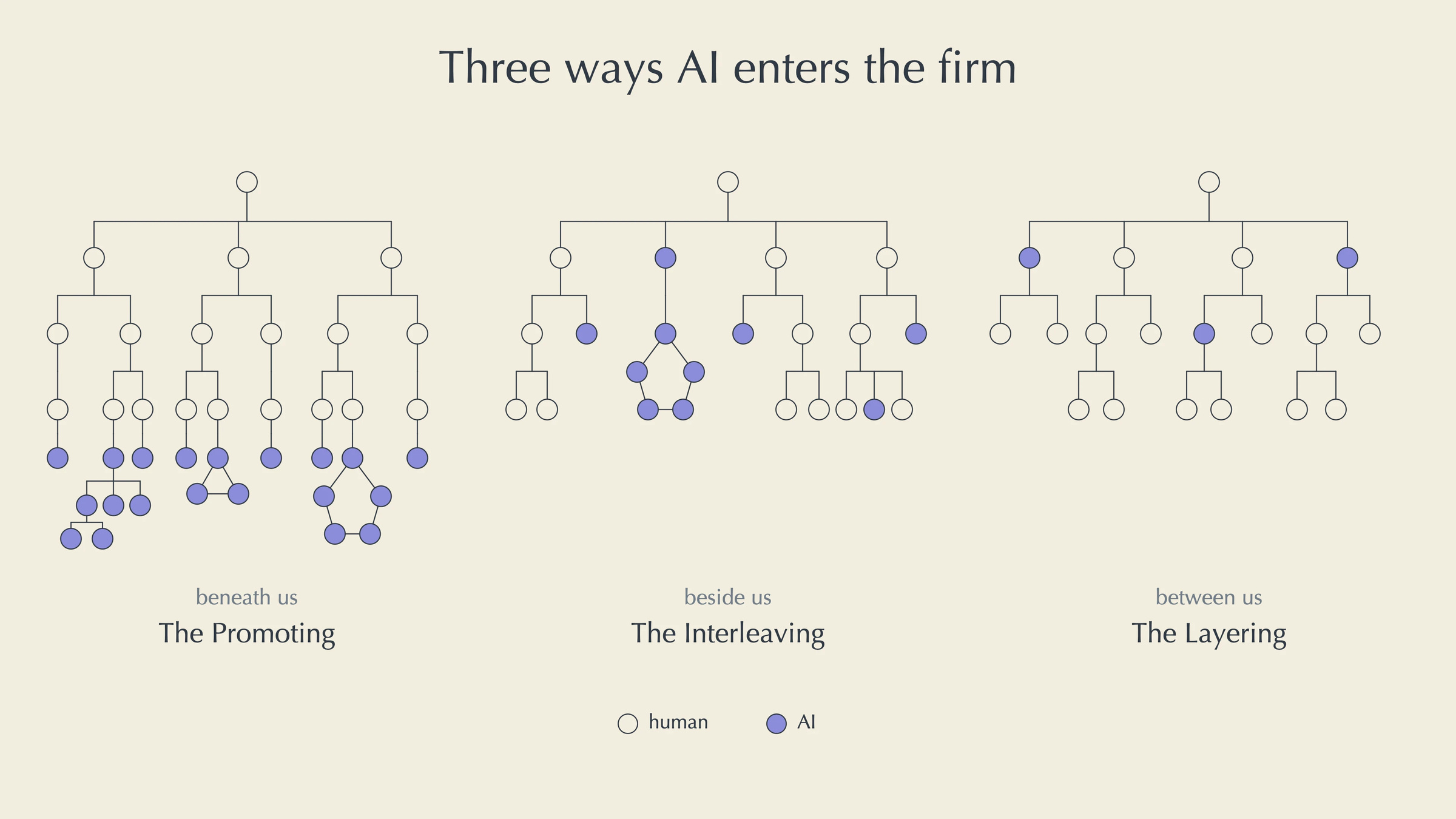
Image: OpenAI
The issues most directly relevant to employees are work processes, autonomy, and wage gaps. The authors also take up how AI could affect firm size. In weighing the role AI plays within an organization, they look at what work employees will take on, how much of it, and in what kind of environment.
The essay broadens the conversation about using AI from individual tasks to the domains of teams and management. What remains to be seen is how well AI can actually perform the roles the authors lay out. In particular, the open question is how to evaluate the ability to coordinate an organization, beyond gathering information or giving advice.