Cerebras Shows How It Splits Trillion-Parameter AI Across Multiple Wafers
The layers of a large model are distributed across multiple wafers, with requests from many users handled at once. Using Kimi K3 as an example, the company calculated it would take 59 wafers.
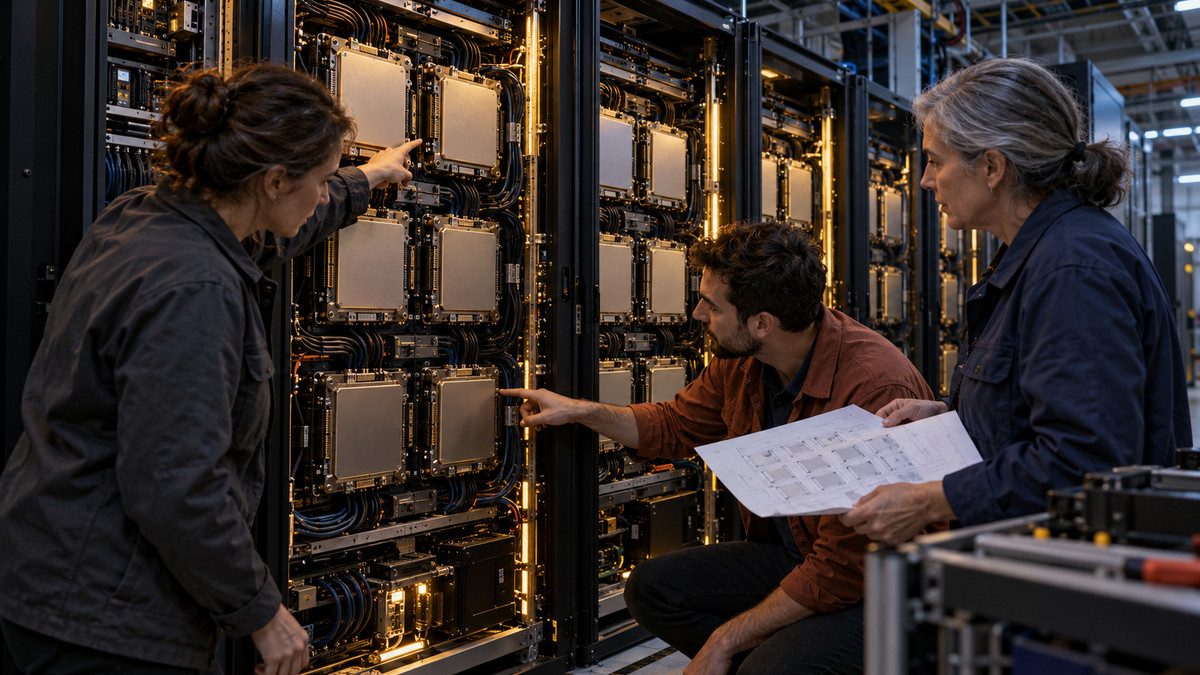
Cerebras on October 22 (local time) detailed how it runs trillion-parameter AI models by spreading them across multiple wafers. The setup bundles several of the company’s WSE-3T wafer-scale chips together. Each layer a model passes through when generating an answer is assigned to a particular wafer. The company used Kimi K3 as a worked example to show how many wafers such a model would need.
How a huge model gets split up
The layers that make up the model, along with the weights (the numerical values learned during training), are held in memory inside the wafers. Between layers, only computed results are passed along. Requests from different users move through different stages of the pipeline at the same time. The company explained that the number of requests it can handle concurrently depends mainly on the memory set aside for storing conversation history.
Where the figure of 59 wafers comes from
The number of wafers required varies with how many layers a model has and what kinds of layers they are. A single wafer holds 44GB of on-chip memory. In the Kimi K3 example Cerebras laid out, weights are compressed to 4 bits and the cache that retains conversation history is stored at 8 bits. Distributing the layers across wafers by type, Cerebras calculated that 59 wafers would be needed in total. The assumption that an average request runs 256,000 tokens is used when counting how many requests can be served concurrently.
How far the 2,000-per-second claim has been verified
Cerebras says it generates 1,000 to more than 2,000 tokens per second on models with multiple trillions of parameters. The cases with published measured results, however, involve smaller models. In May 2026, Cerebras made Kimi K2.6, a model of roughly 1 trillion parameters, available to enterprise customers for testing. The generation speed measured externally at the time was 981 tokens per second. The figures comparing its speed with GPU-based clouds also come from that K2.6 trial. This latest write-up spells out in concrete terms how the layers of a larger model would be laid out across multiple wafers.
When will it be available in Korea?
Cerebras says developers can start for free on its own inference cloud, hooking the service into their own applications. Free access is intended for development, evaluation, and experimentation rather than production operation. Companies looking to deploy AI separately can go through the company’s sales contact channel. Which models are available, along with capacity and performance, depends on the terms of use, the company said. It did not disclose a start date for Kimi K3 availability or any dedicated pricing.
For the Korean market, a partnership with Upstage was presented as the path forward. In July 2026, Cerebras announced it was teaming up with Upstage to promote the use of AI inference technology in Korea. It did not disclose a Korean launch timeline for the Kimi K3 deployment approach described here, or the terms of Korean-language support.
What this amounts to is a concrete, numbers-based picture of the memory and hardware configuration required to run large AI models. For companies looking to build AI into their workflows, it offers a basis for weighing not just model size but also request length and concurrent throughput. The questions now are how fast this approach performs in production and what its access terms and costs will be.