Ai2 Unveils LitPivot, Which Refines Research Ideas Using Evidence From Papers
Pick the part of a research plan you want to fix, and it organizes the relevant papers, then proposes revisions backed by quoted evidence. In a study with 17 researchers, it helped them write proposals more firmly grounded in the literature than a baseline tool did.
Ai2 has released LitPivot, a system that helps researchers refine their research ideas. It was developed together with researchers at the University of Pennsylvania. Pick the part of a research plan you want to revise, and the tool organizes the relevant literature for you, then proposes revisions alongside the supporting sentences from those papers. The researcher chooses which papers to run the review against. Each suggestion can be accepted as is, edited, or rejected. The team built it as a tool for the early stages of shaping a research idea, and will present it at UIST 2026 in Detroit.
Splitting a research plan into three parts
LitPivot zeroes in on the moment when reading a paper makes you change course. The researchers went through meeting records from four completed computer science projects and identified 21 instances of these pivots. They came in two flavors: establishing originality by differentiating the work from existing research, and building on prior results to push an idea further. An earlier observational study of five researchers found that participants struggled to test the soundness of an idea against related work while that idea was still growing.
The workflow is simple. You write a short research plan, then turn on a feature that marks it up in three parts: the problem to be solved, the new contribution, and the evaluation plan. Click one of those parts and papers retrieved through Asta Paper Finder (Ai2’s paper search tool) are sorted into clusters that match its content. Select the evaluation plan and you can browse the papers by evaluation method. Choose a set of papers and request a review, and LitPivot returns its critiques together with the supporting passages and proposed revisions.
Revise the idea, and the supporting papers shift too
The review criteria differ for each part of the plan. For the section describing the problem, it checks whether the problem actually exists and matters. For the section describing the new contribution, it compares the results, limitations, and future-work suggestions in existing papers to identify what remains open. For the evaluation plan, it examines whether the proposed experiments can answer the research question, and what methods comparable studies used.
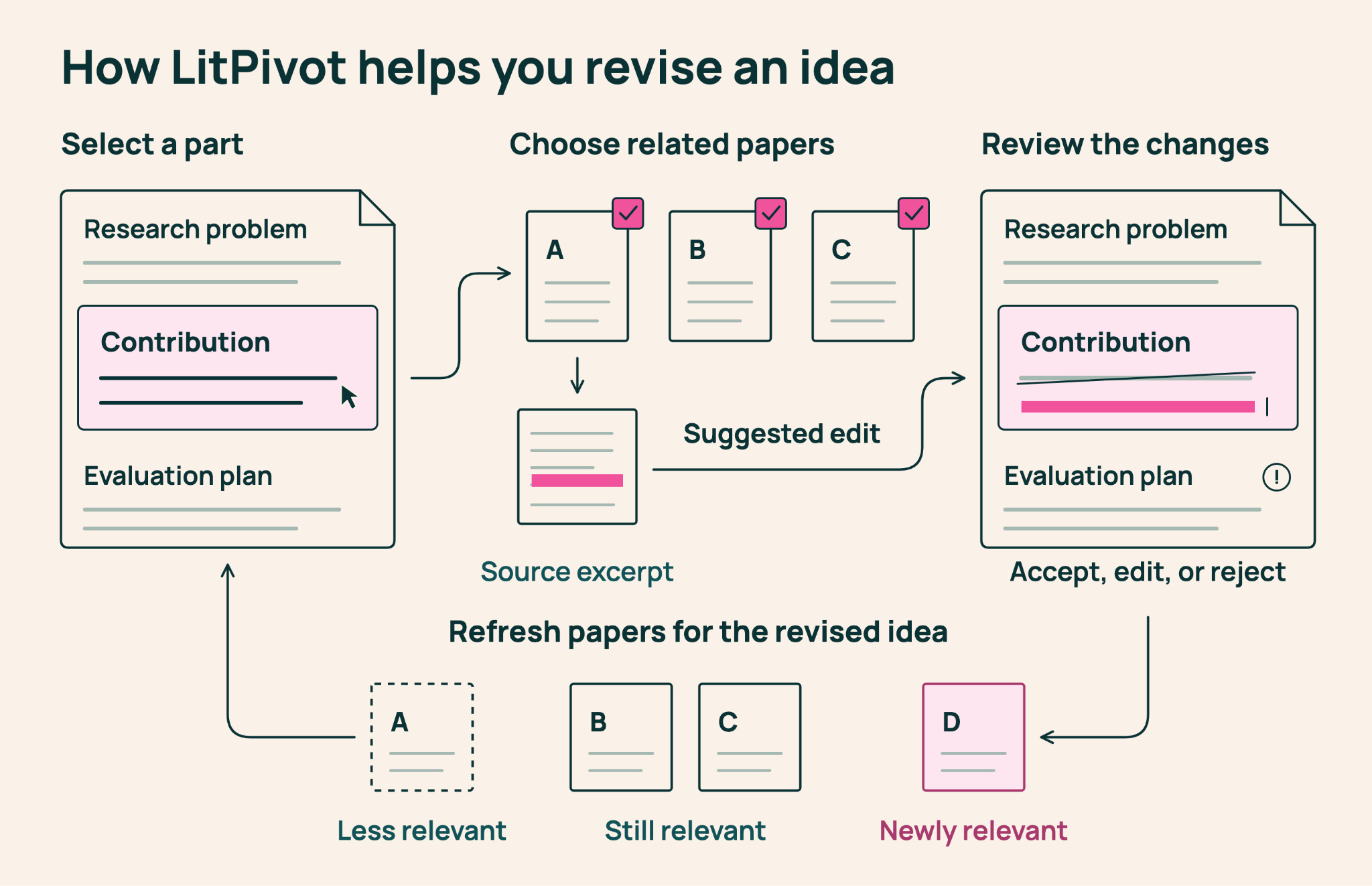
Image: huggingface.co
When a researcher edits the plan, the relevant papers are re-ranked. The tool also flags passages that need to be updated in tandem, such as when a changed contribution leaves the existing evaluation plan out of step. One study participant started from an idea about generating synthetic medical records that were factually accurate and internally consistent. They then shifted their focus to consistency across records from multiple visits, and excluded papers dealing with single-visit records from the review set. After another round of review, the scope narrowed to the problem of detecting contradictions across multiple visit records.
What changed when 17 researchers tried it
The team asked 17 researchers to develop one assigned idea with LitPivot and another with a baseline tool. The baseline was a document editor plus an AI tool for asking questions about selected papers. Both conditions used the same set of papers. Two domain experts, blinded to which tool produced which text, evaluated the results. The criterion was how well the idea was grounded in relevant literature, and the proposals written with LitPivot scored higher.
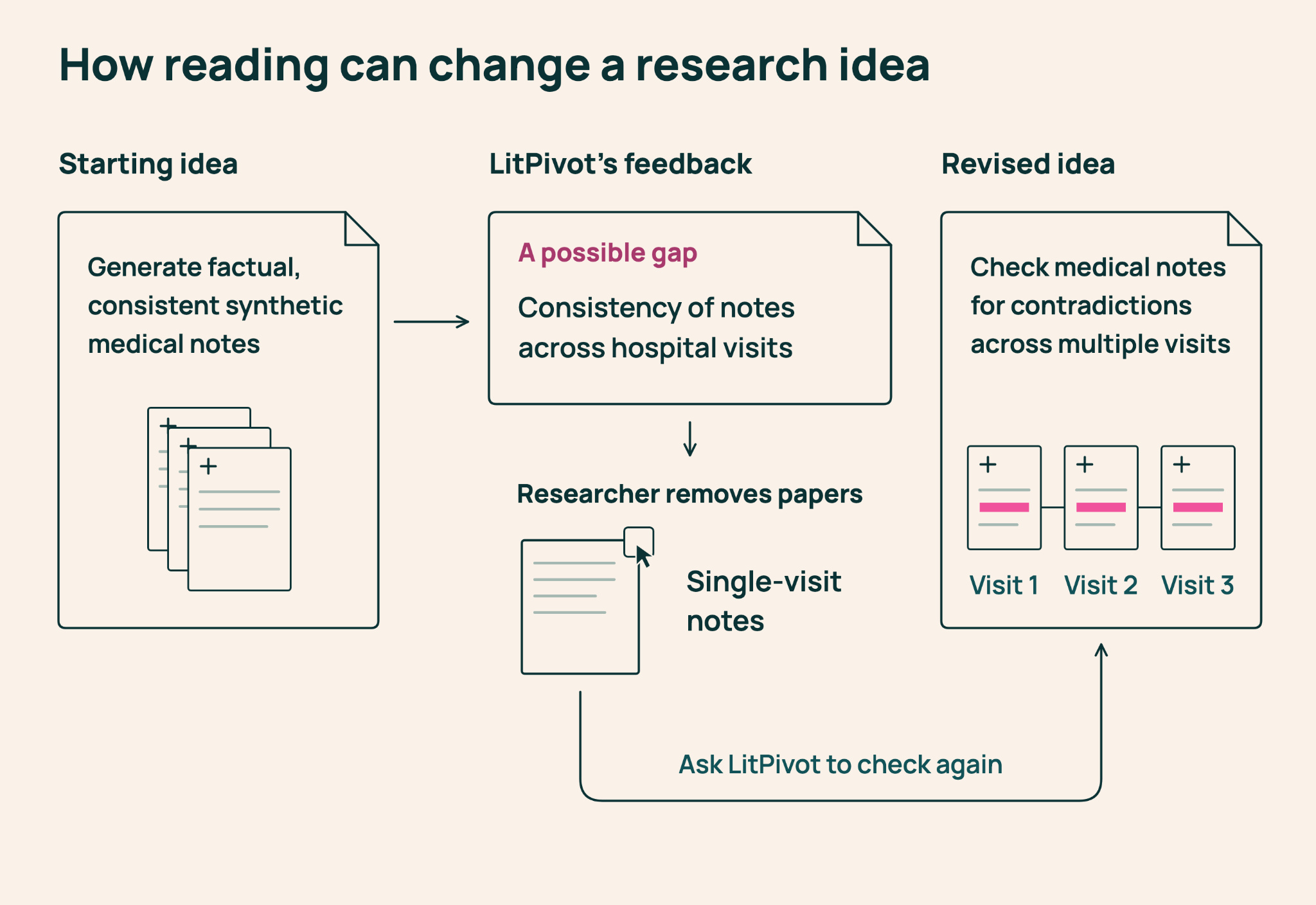
Image: huggingface.co
Participants reported that they understood the related literature better with LitPivot, and that the originality and usefulness of their ideas improved as well. In a follow-up study, five researchers spent 30 minutes each using LitPivot on a project already in progress. Two checked a new idea against the literature, while three refined how they framed an idea they had already developed.
What LitPivot proposes as a way of working is to revise the idea and choose the supporting papers at the same time. Before accepting a revision, the researcher can check the supporting passage, and can also swap out which papers get reviewed as the concept shifts. The team says the tool can support both early exploration and the refinement of an existing research direction. The open question is whether more faithful use of the literature actually translates into more original and useful research.