Nvidia's Kumo Relational Predicts Customer Churn With No Task-Specific Training
It predicts customer churn and demand straight from enterprise data spread across multiple tables. Nvidia says it outperformed existing prediction models on 41 tasks across 15 databases.
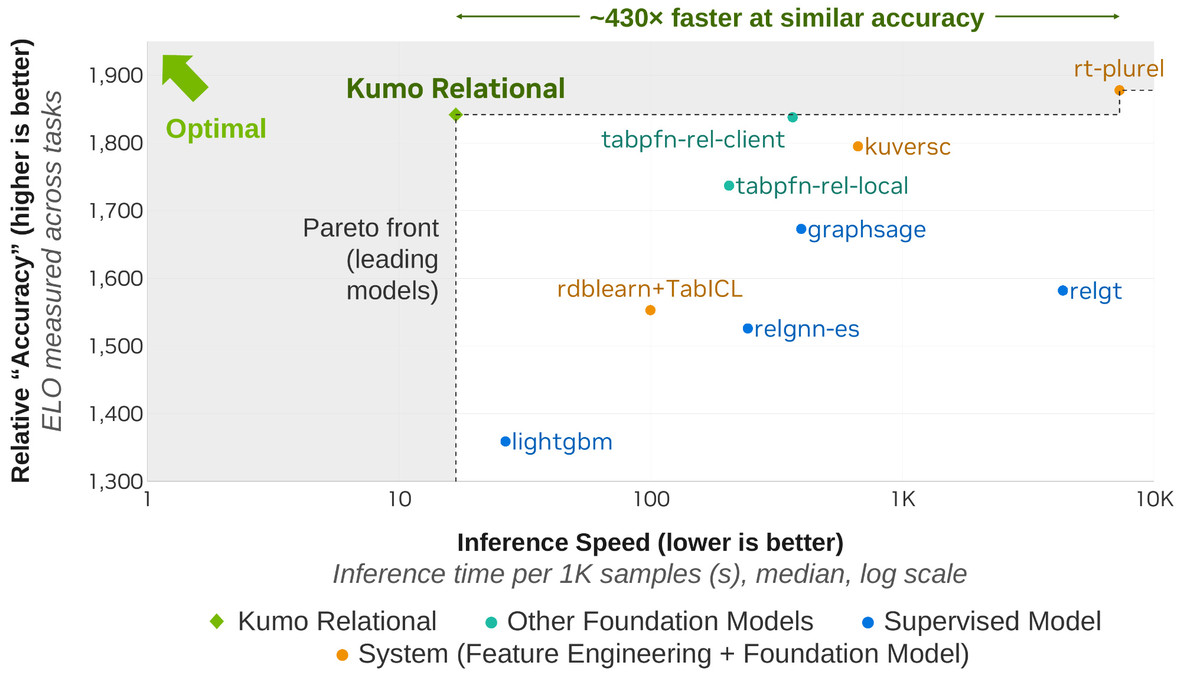
On October 21, Nvidia unveiled Kumo Relational, an AI model that makes predictions directly from enterprise databases. Users point a pre-trained model at whatever they want to predict, and it predicts things like customer churn, demand, or whether a case involves fraud. According to Nvidia, there is no need to train a fresh model for each task, and no need for people to hand-build the individual features used in a prediction.
Why the table-joining step disappears
Enterprise data is spread across multiple linked tables: customers, orders, products, and so on. Until now, prediction work meant merging all of that into a single table and having someone manually craft features such as “average order value over the past 30 days.” Nvidia says this takes considerable effort, and that fine-grained relationships within the data can be lost along the way.
Kumo Relational preserves the links between tables and the time information as it processes the data. It was pre-trained on synthetic data modeled on real databases. For a new task, it makes predictions by referring to up to 10,000 past cases whose outcomes are already known. When higher accuracy is required, additional training tailored to a specific dataset and task is also possible.
Does it beat existing prediction models?
Nvidia says it tested the model on 41 tasks across 15 databases spanning e-commerce, healthcare, and enterprise operations. The data used in testing was not used during pre-training. In tests involving classifying targets or predicting numerical values, the company says the model outperformed both conventional models trained on labeled data and models whose prediction features were designed by experts.
Image: huggingface.co
On SAP SALT, an enterprise data benchmark, the comparison used a score that measures how highly the correct answer is ranked (MRR). According to Nvidia, Kumo Relational scored 8% higher than AutoGluon, which combines multiple models. After additional training, the gap widened to 16%. On another benchmark, RelArena-α, the median time to process 1,000 prediction targets was about 17 seconds. The highest-scoring model took about 7,300 seconds, and its accuracy score was higher than Kumo Relational’s.
The company says performance is especially strong on data where relationships and change matter, such as customer behavior that shifts over time. It also noted that for tasks with very large amounts of training data, a model trained specifically for that task may do better. If the information needed for a prediction sits too far away across tables, there are limits, so Nvidia advises starting with a few related tables and expanding the scope from there.
How enterprises can put it to work
Enterprise AI teams can load the model from the open-source software Nvidia has released. Another option is to stand it up as a separate service in the form of NVIDIA NIM. The model runs in a GPU environment and is downloaded from Hugging Face on first use. Nvidia says the model is designed to take prediction requests from agentic AI, which handles tasks on its own, letting teams add questions such as a given customer’s expected future order volume to a workflow.

Image: huggingface.co
This release is focused on reducing the data-preparation and model-training burden of starting a new prediction task. Teams looking to forecast customer churn or demand can cut down on building a separate model for every task. What remains to be verified is whether accuracy and processing speed hold up on a company’s own data, how much GPU capacity the model needs, and what it costs to operate.