SK Telecom Teams Up With Seoul National University Mathematicians to Sharpen Its A.X K2 Model
Working with researchers from Seoul National University, KAIST and the Korea Institute for Advanced Study, the company wants to tackle open problems in mathematics and build AI that can check its own reasoning and results while handling complex tasks.
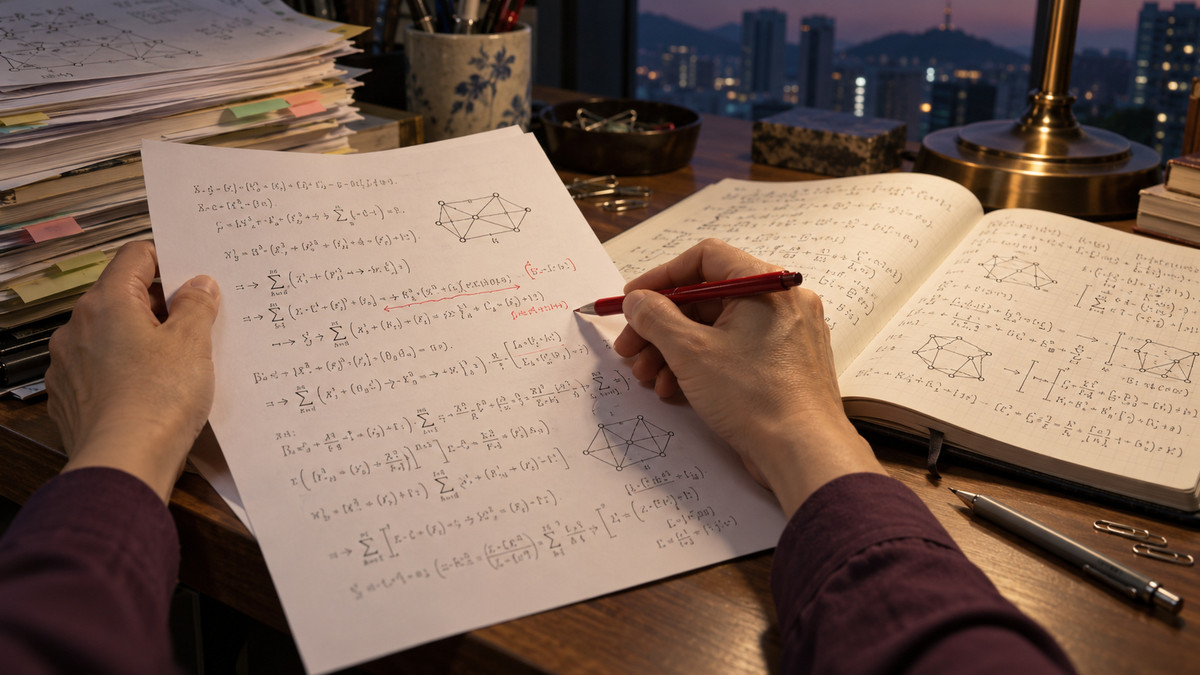
SK Telecom is joining forces with mathematics researchers in South Korea to improve the problem-solving ability of its in-house AI model, A.X K2. On October 22 the company said it would feed mathematicians’ domain expertise into model training and then use the upgraded model to take on difficult open problems in mathematics. The results, it said, will go toward making agentic AI, which carries out tasks on its own, better at checking its own judgments and outputs.
The company is holding a technical exchange session at its headquarters in Euljiro, Seoul, on the same day, bringing together researchers from Seoul National University and KAIST to discuss how the collaboration will work. Attendees include professors Insuk Seo, Sungsoo Byun and Youngjoon Hong of Seoul National University’s Department of Mathematical Sciences, professor Noseong Park of KAIST’s School of Computing, and student researchers. The agenda covers how A.X K2 can be used in mathematical research and how to improve the model’s performance.
How do you get a mathematician’s knowledge into an AI?
The collaboration focuses on training the model deeply on specific subfields of mathematics. SK Telecom said it wants to shore up the specialized knowledge and step-by-step logical reasoning that existing models have not handled well enough. The approach is to add the knowledge required to solve mathematical problems to the model, then apply it to real research questions.
Researchers from the Korea Institute for Advanced Study are also taking part. Professor Insuk Seo of Seoul National University is contributing in probability theory and statistical physics, while professor Joonkyung Lee of the Korea Institute for Advanced Study covers discrete mathematics and graph theory. Professor Sang-hyun Kim, also of the Korea Institute for Advanced Study, brings research strength in low-dimensional topology and geometric group theory. Each researcher will work on open problems in their own specialty.
The project will also study how to use AI in mathematical research itself. Professors Youngjoon Hong, Dabin Lee, Byeong-Kweon Oh and Sungsoo Byun of Seoul National University and professor Noseong Park of KAIST are involved in this part of the work. The task is twofold: train the model on mathematicians’ expertise, and find ways to put the trained model to work in actual mathematical research.
Why does agentic AI need mathematics?
The link SK Telecom draws between mathematical research and workplace AI is judgment and verification. The company said it wants to improve the model’s ability to assess whether its process and results hold up when the AI draws up a plan for a complex problem and executes multiple steps of work. In other words, it wants AI that keeps an eye on its own reasoning while getting the job done.
That capability is also slated for use in research on AI that improves its own performance. SK Telecom tied this collaboration to work on AI that raises its own capabilities and then feeds those gains back into the next round of improvement. What matters, the company said, is the ability to judge whether not only the answers the AI produces but also the experiments and verification methods it designs for itself are mathematically sound.
Kim Tae-yoon, head of foundation models at SK Telecom, said the company is “actively pursuing industry-academia collaboration in the field of mathematics in order to improve the real-world problem-solving ability of our proprietary foundation model.” The company described an AI agent that learns the knowledge it needs on its own and keeps improving as its long-term goal.
The thing to watch from here is what subfield-specific training actually delivers in research on hard open problems. Whether the same work also sharpens the judgment and verification skills of task-handling AI will help determine the value of this research.