AWS Releases Tool That Runs PyTorch Code As-Is on Its Own AI Chips
An open-source tool that lets PyTorch code run on Trainium, AWS's AI chip, has entered public beta. The number of models that work without modification has jumped sharply.
Amazon Web Services (AWS) released TorchNeuron in public beta on October 20. It is an open-source tool that bridges PyTorch, the most widely used framework in AI development, and Trainium, the AI chip AWS builds itself. It works on Trainium2 and Trainium3 instances in the AWS cloud. The idea is to widen the range of chips available for training and running AI while letting developers keep the tools they already use.
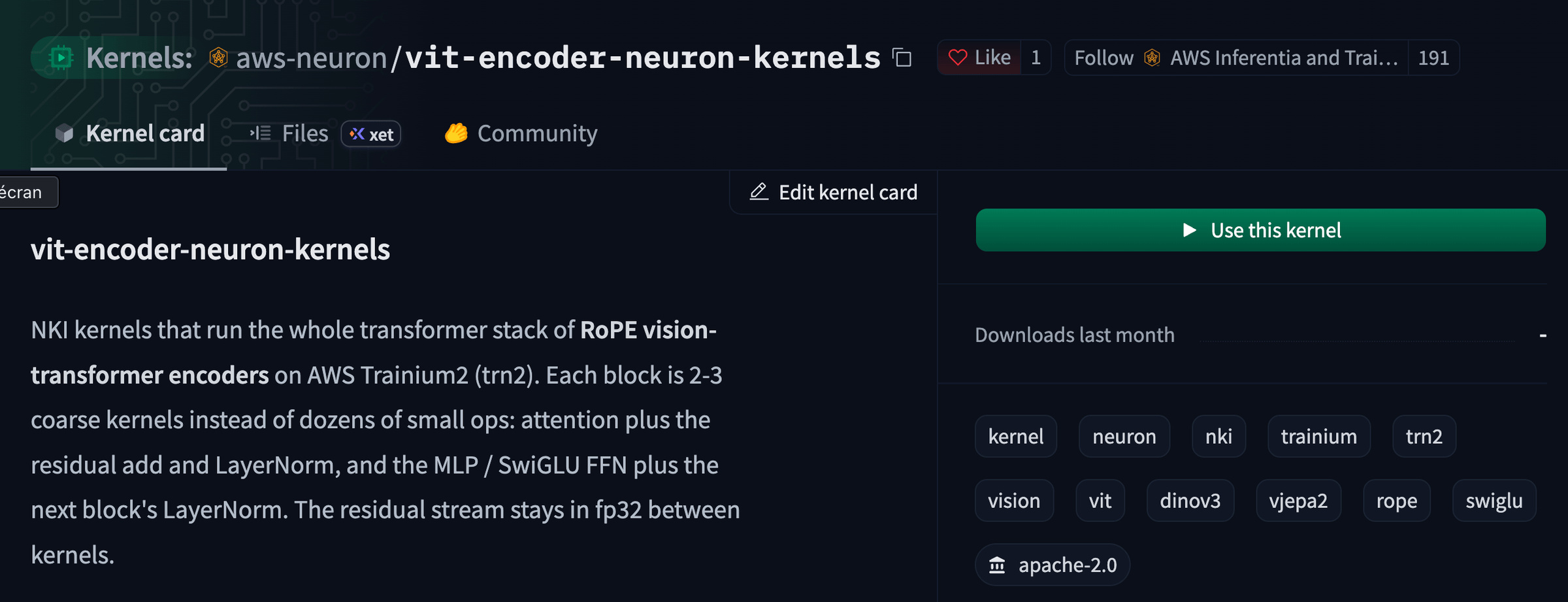
Image: huggingface.co
How much existing code can you reuse?
With TorchNeuron, PyTorch recognizes Trainium directly as an execution device. A basic migration amounts to changing the part of the code that specifies which chip to run on. The tool supports running operations immediately as they are issued, optimizing the execution code ahead of time, and splitting training across multiple chips. That reduces the burden of learning a separate Trainium-specific workflow from scratch.
Hugging Face had previously supported Trainium through a separate tool called Optimum Neuron. The company explained that it had to maintain dedicated code of its own in order to hide a complicated process that involved fixing input shapes and recompiling code. Now it recommends using Hugging Face’s standard model inference and training tools directly. That said, this does not mean that computation code written exclusively for Nvidia GPUs can be made to run with a mere configuration change.
89% model support: what grew?
According to Hugging Face, 89% of the top 100 most widely used text generation model architectures run as-is without modification. That is 43 percentage points higher than the 46% recorded with Optimum Neuron v0.4.5. In other words, the range of models that can be ported over and run on Trainium has widened by that much.
Image: huggingface.co
What about cost? AWS is pitching Trainium’s price-performance. According to AWS, the voice AI company Deepgram moved to Trainium using plain PyTorch and saw a 70% increase in the volume of audio it could process per dollar.
How does it work for text and image models?
Beyond text generation, Hugging Face also published examples covering additional training and image generation. It said it completed fine-tuning of Qwen3-8B on eight Trainium2 chips, and that the saved model is in a standard format that can be loaded on other hardware as well. That matters for development teams that want to take training results from Trainium and use them in other environments.
Image: huggingface.co
In Diffusers, the image generation library, the company said workloads in the FLUX.1-dev, FLUX.2, and Qwen-Image families can be split across multiple chips. Developers can also optimize specific operations themselves and share them on the Hugging Face Hub. TechCrunch and AI Times read this trend as a challenge to Nvidia’s software ecosystem, focusing on the fact that it makes familiar development tools usable on other chips.
What to check before adopting it
Being a public beta, it comes with limits. The feature that optimizes execution code ahead of time does not yet handle automatic adjustment when input shapes change. If you keep input shapes consistent, you can keep reusing code compiled once, but a new shape may force a recompile. Some PyTorch features are also missing from the support list. If the CPU has to handle unsupported operations instead, performance can drop, so it is best to test directly with the inputs and code you use in production.
For development teams in Korea, the deciding factors are the same: how little of your existing work you have to rewrite in order to migrate, and how much you can process for the same money. Whether broader model support actually translates into cost savings on real workloads is the thing to watch going forward. When weighing adoption, check the available AWS regions, pricing, and per-model compatibility together.