110 Students With Disabilities Made Posters and Videos With AI
SK Telecom and the Korea Differently Abled Federation co-hosted the "Happy AI Challenge." What was once a coding-focused contest has widened into making things with AI and solving problems with it. Students produced posters and videos, and worked in pairs on tasks covering AI ethics and information search.
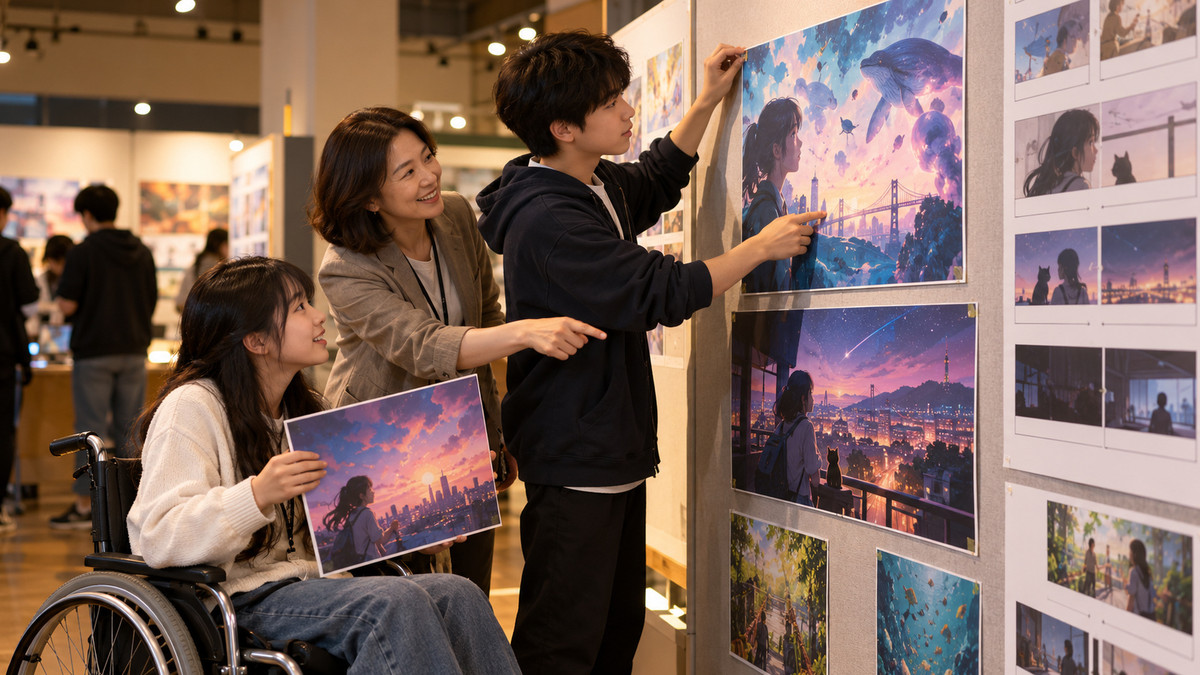
SK Telecom held the “2026 SK Telecom Youth Happy AI Challenge” on October 14 and 15 at the company’s Human Resources Development Center in Icheon, Gyeonggi Province. The event, co-hosted with the Korea Differently Abled Federation, an umbrella group for disability organizations in Korea, drew 110 students with disabilities and 44 supervising teachers. Participants used AI to create posters and videos, and worked in teams to solve a set of assigned problems.
How a coding contest changed
This year the event dropped its former name, the “Happy AI Coding Challenge,” and widened the scope of its tasks. Rather than stopping at coding skills, the contest focused on the process of expressing ideas through AI and then refining the output. SK Telecom said the tasks were designed to measure what students could actually make, rather than how much they knew about AI.
SK Telecom began its digital education work for young people with disabilities in 1999 with an information search competition. Since 2019 it has supported coding and AI education through the “Happy AI Coding School.” This year’s contest ran in three categories: the Mission Challenge, the Vision Challenge, and the Hope Challenge.
What the students created
The Vision Challenge, for students with developmental disabilities, centered on poster design. Working from a theme and a list of required elements revealed on the day of the event, students used Canva’s AI image generation and editing tools. They wrote prompts, the instructions given to an AI, then reviewed the resulting images and polished the wording and design.
In the Hope Challenge, aimed mainly at students with disabilities other than developmental disabilities, participants produced roughly 30-second videos. They used A. (pronounced “A-dot”), SK Telecom’s AI service, to work out the story and the specific conditions for the video, then finished the piece with CapCut’s AI video generation and editing features. The heart of the task was turning the ideas in their heads into a concrete set of instructions.
The Mission Challenge, open to students with any type of disability, paired participants in teams of two. Within a 30-minute limit, teams tackled true-or-false questions on AI ethics, a route-finding task, a cultural heritage information search, and a code-breaking puzzle built on QR code clues. Numbers drawn from the four correct answers opened a padlock, and the team then hit a buzzer. It is a cooperative event that requires partners to exchange ideas and divide up the work.
How the students changed
Supervising teachers said they saw shifts in their students’ engagement and confidence during preparation. Kim Mi-ri, a teacher at Pohang Myeongdo School, said that practicing in an escape-room style format led students to voice problem-solving strategies and opinions of their own. Jang Ji-hyun, a teacher at Mudeung Middle School in Gwangju, said her students proudly told classmates about studying AI and using QR codes, and were cheered on by their friends.
Beyond creating work, the venue offered hands-on experience with the technology itself. Activities included augmented reality (AR) racing and archery, which overlay virtual elements on a real-world view, along with drone piloting simulations and robot coding. Student recreation sessions combined audio description, large-text captions, and physical demonstrations by the host. The format was built around reaching shared goals rather than eliminations or penalties.
The contest expanded the chances for young people with disabilities to express their own ideas through AI and solve problems alongside their peers. SK Telecom said it will continue to offer digital education and hands-on programs for youth with disabilities.