CERN and Mistral AI Team Up to Build an AI Model for Particle Collision Analysis
The plan is to train an AI on billions of simulated collisions and use it for a range of research tasks. The two organizations announced on October 15 that they had signed a statement of intent for long-term cooperation.
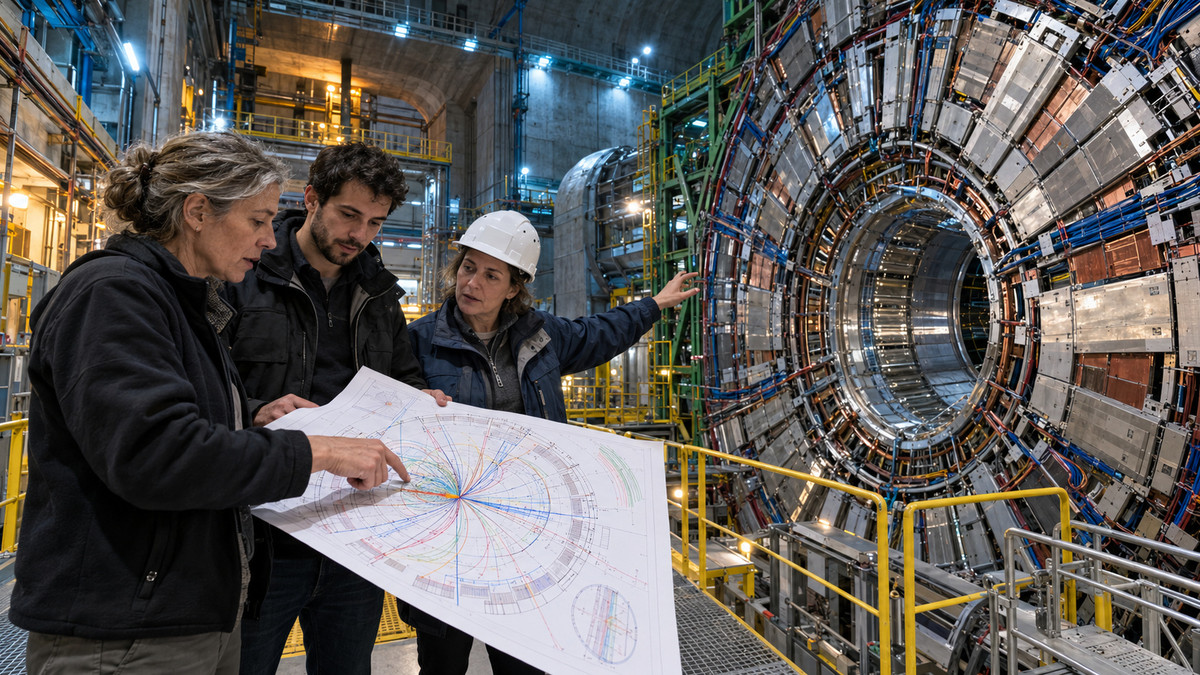
CERN and Mistral AI are joining forces to build an AI model for scientific research. The two organizations announced on October 15 that they had signed a statement of intent for long-term cooperation. The plan is to jointly develop a model that can analyze experiments at the Large Hadron Collider (LHC).
The first goal is to train an AI on billions of simulated proton collisions. From that foundation, the idea is to build a single model that can be applied broadly across multiple research tasks. The intended scope ranges from interpreting particle collisions to evaluating future experimental equipment.
What changes in particle collision analysis
Today, collisions are analyzed by passing them through a series of specialized algorithms. The process converts the signals left in the detectors into particle information that researchers can read. CERN noted that machine learning is already used for individual tasks within that chain. The new collaboration focuses on extending the use of AI across the analysis process as a whole.
The jointly developed model is intended to handle several tasks, such as reconstructing collisions and identifying the types of particles involved. Searching for signals that deviate from expectations is also on the list of intended uses. The difference from the current approach is that analyses previously handled task by task would be processed by a single model.
The envisioned applications also include evaluating the design of future detectors. Beyond interpreting collision data, the same model would be used to review designs for equipment destined for future experiments. For researchers, the change would be in using one model across different stages of research.
10 times more collisions around 2030, and why AI is needed
CERN said the LHC experimental data stored so far amounts to roughly 1 exabyte. It also projected that the number of collisions will increase tenfold at the High-Luminosity LHC, which is expected to begin operating around 2030. The data already accumulated and the scale of collisions still to come are the backdrop for this joint development effort.
What ultimately becomes available to researchers depends on how the work proceeds and how it is shared. CERN set out the goal of building the capacity to share the results of the development with the physics community. For now, the announcement centers on a plan to build a research model and apply it to a variety of analysis tasks.
The collaboration is an attempt to expand AI from a tool used in individual analyses into a model that can handle a range of physics research tasks. What to watch from here is how well a single model performs on jobs such as collision reconstruction and particle identification. How the results are shared with the physics community will also be a deciding factor in whether researchers adopt it in practice.