Google Unveils Three AI Studies on Using Experimental Results to Refine Molecular Designs
The approach screens out commands lab robots cannot physically execute and uses real measurements to revise the next round of molecular candidates. It was also applied to designing binders that latch firmly onto a protein overproduced in cancer.
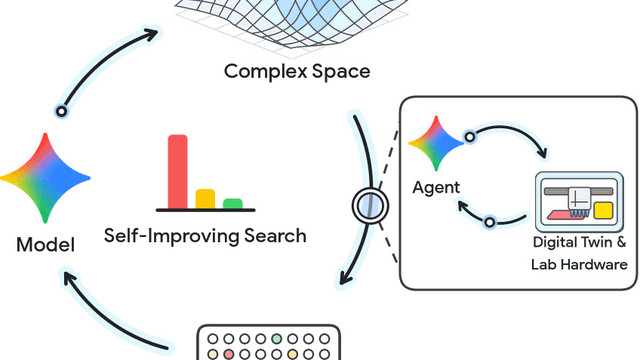
On October 16 local time, Google unveiled three research efforts aimed at connecting AI-driven molecular design with real-world biology experiments: VERID, a system that checks commands sent to laboratory robots; the design of DNA fragments that latch onto proteins; and the design of binders for a cancer-related protein. Together, they lay the groundwork for a lab in which humans set the research direction while AI iterates through design and analysis of results.
Can a robot actually carry out the experiment commands AI writes?
Robot commands written by AI can be grammatically correct and still fail on the bench. A pipetting tool meant to draw up reagent may not fit into a container, or the AI may try to withdraw liquid from a vessel that is already empty. VERID records everything from the geometry of the robot arm to the liquid volume in each container, the identity of each reagent, and the stock of consumables in a virtual laboratory, so that these physical constraints are checked in advance.
Google said that in experiments using VERID, the AI revised its own liquid-mixing procedure. Even after a measurement instrument broke down, it continued the task without re-transferring liquids. The company also described a case in which the virtual lab rejected a motion that would not fit inside a narrow container, prompting the AI to change its plan. In a repeated experiment that required identifying unlabeled dye mixtures from camera footage, Google said accuracy improved more than fivefold.
A design that started at a 0% success rate, and how it reached 42%
The second study dealt with “aptamers,” DNA fragments that bind to a specific protein. The AI designed candidates, real experiments sorted out which ones actually bound, and those results fed back into the next round of design. A single cycle, from design through testing and analysis, took seven to ten days. Google ran the process three times against two proteins: myoglobin and alpha-thrombin.
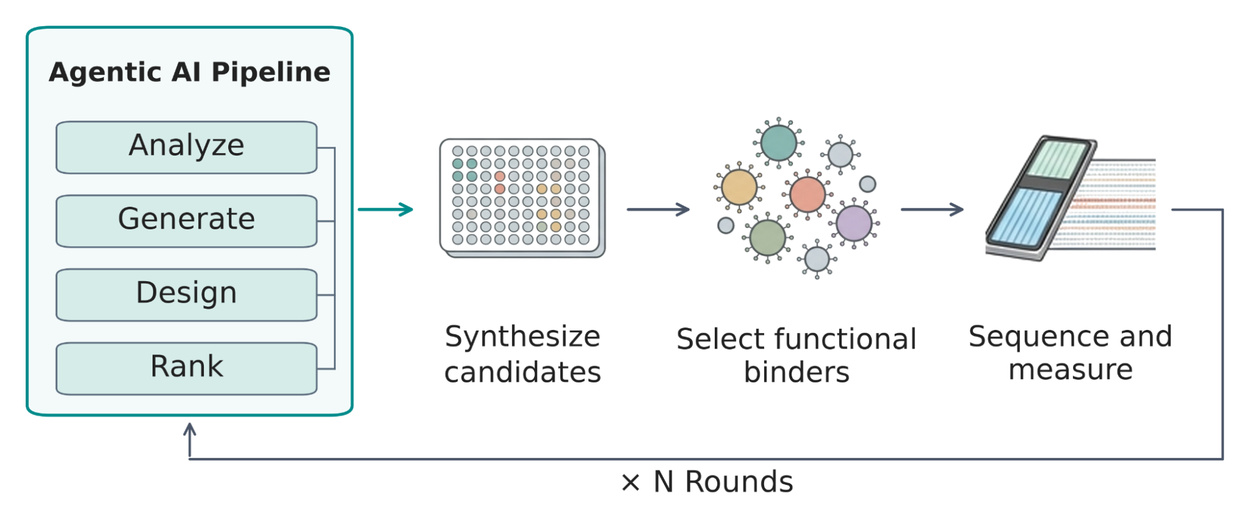
Image: research.google
The myoglobin experiment showed that candidates that look like strong binders can in fact be the wrong choice. In the second design round, the AI pushed for binding strength and ended up producing more candidates that also stuck to other proteins and to the magnetic beads used in the assay. Once the bead-binding effect was subtracted, the success rate for binding the target protein fell from 10.2% to 3.7%. In the third round, after the AI revised its design rules based on the experimental results, it rose to 33.5%.
With alpha-thrombin, the binding success rate in the first experiment was 0%. Google explained that fixed sequences appended to the DNA interfered with proper folding in 48% of the candidates. After the AI changed the structure and broadened the diversity of candidates, the success rate climbed to 26.0% in the second round and 42.1% in the third. In both cases, the causes of failure revealed by real experiments became the clues that reshaped the next design.
Applied to FAP, a cancer-related protein
The third study targeted FAP, a protein produced in high amounts in solid tumors. Google said that within a few experimental rounds it obtained protein binders with strong, single-digit nanomolar binding affinity. For the computational work, instead of handling the entire target protein, the team carved out only the region around the binding site. Google said this approach maintained structure-prediction accuracy while making the computation required for one design cycle more than eight times faster.

Image: research.google
Google said that, given the same computing resources, designs produced jointly by scientists and AI had a predicted success rate nearly twice that of designs produced by scientists alone. In the collaboration, scientists set the broad strategy while the AI handled the detailed execution. To speed up the wet-lab work, the team also introduced a method that screens protein candidates en masse using fluorescent signals.
As a next step, Google plans to combine VERID’s automation capabilities with the iterative learning loop used for protein discovery. Open questions remain. Among them: whether the AI finds candidates that genuinely bind the target protein rather than exploiting loopholes in the assay, and whether humans can verify and oversee experiments that unfold across many sequential steps.