Meta Releases Muse Spark Open: Download It and Run It Yourself
A model that reads text, images, audio and video can now be downloaded and run on your own hardware. Free use comes with strings attached, and running it yourself demands an enormous amount of GPU memory.
Meta released the model weights for Muse Spark Open on October 15 local time. Weights are the data that captures what an AI has learned through training. Anyone can download that data and run the model on their own hardware. Meta points to coding and agentic work, where the AI handles a multi-step task on its own, as the main use cases.
A model that reads video, and how well it performs
Muse Spark Open accepts images, audio and video as well as text. Its output is text. It can take in up to 1,048,576 tokens at once. A token is the chunk of text an AI works with when processing language. The model has 816 billion parameters, of which only about 42 billion are used at each step of generating a response.
This release widens the options for using the Muse Spark family. Meta announced the first Muse Spark in April and made it available through the Meta AI app and on the web. Muse Spark Open is the public version that users can run themselves. Developers can also choose to plug it into their services through third-party providers.
In its own benchmark testing, Meta reported scores of 61.8 on JobBench, 89.2 on MCP-Atlas and 58.5 on Terminal-Bench 2.1. The same comparison table also lists Qwen3.8, GLM 5.3 and Kimi K3. The Decoder reported that Muse Spark Open performs at broadly the same level as the leading Chinese open-weight models on these benchmarks.
Can you run it on your own machine?
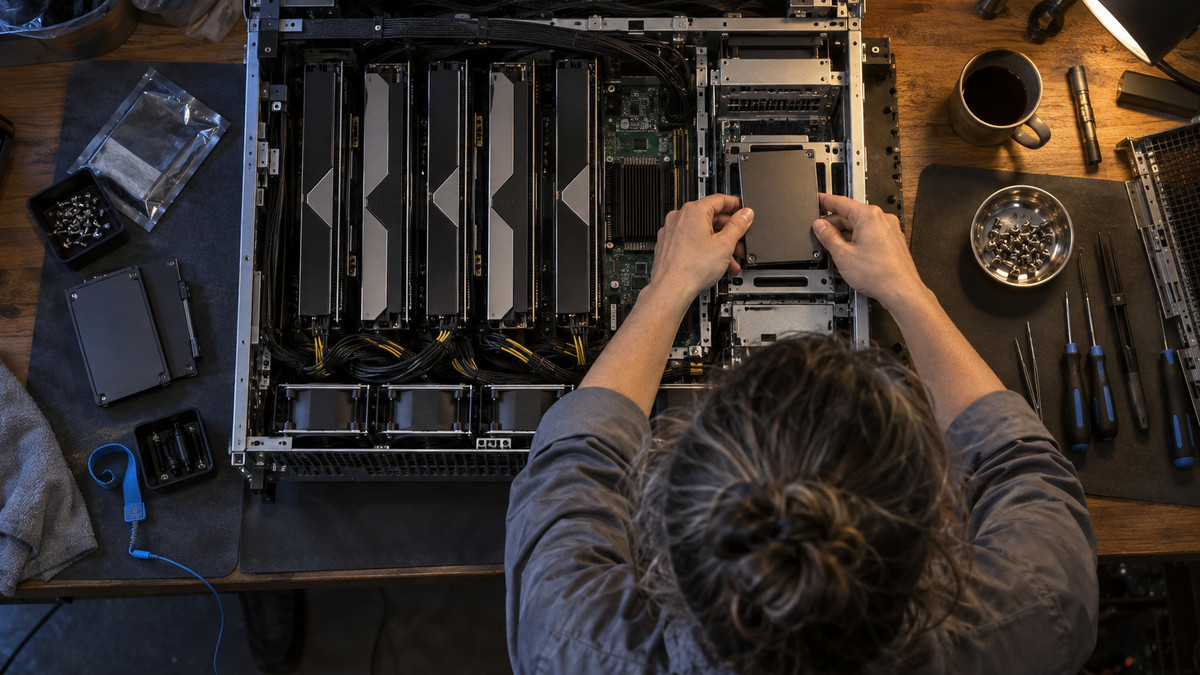
If you want to run it yourself, start with the hardware requirements. Only part of the model is used to generate a response, but the full set of weights has to sit in memory the whole time it is running. According to Meta’s documentation, the weights in the default format come to about 1.65TB, and you should budget around 2TB of GPU memory to operate it. A size-reduced format brings the weights down to about 537GB, with a minimum of 700GB of GPU memory.
Meta says it can also run on two Apple M5 Ultra Mac Studio machines. Users who would rather not assemble their own hardware can go through a third-party service. The weights have been available on Hugging Face and elsewhere since the announcement date. The model can also be plugged into services via Baseten, Fireworks AI, Groq, Modal, Nebius, OpenRouter and Together AI. Pricing varies by provider.
What are the conditions for free use?
The weights are free to use as long as you comply with the license terms. You have to follow Meta’s usage policy and include attribution within your product. Businesses that offer the model as a service face one additional condition: if total revenue over the most recent 12 consecutive months exceeds $20 million, they must enter into a separate written agreement with Meta before deploying the model in a service. Meta says it applied additional safety training and recommends pairing the model with safeguards appropriate to the use case.
Meta says the model was trained on data covering more than 100 languages. Users in Korea will want to weigh how well it handles Korean-language tasks and what terms apply to the third-party services available domestically. In the end, what this release changes is that there is now a choice between running the model yourself and going through a third-party service, and the cost of adoption will come down to hardware, service fees and the commercial use conditions.