Nvidia to Release AI Training Data in 22 Indian Languages, Pipeline Included
Some 2.8 trillion tokens of training data will be released alongside the pipeline that produced it. The goal: port English technical material into Indian languages so AI can explain concepts and solve problems in those languages.
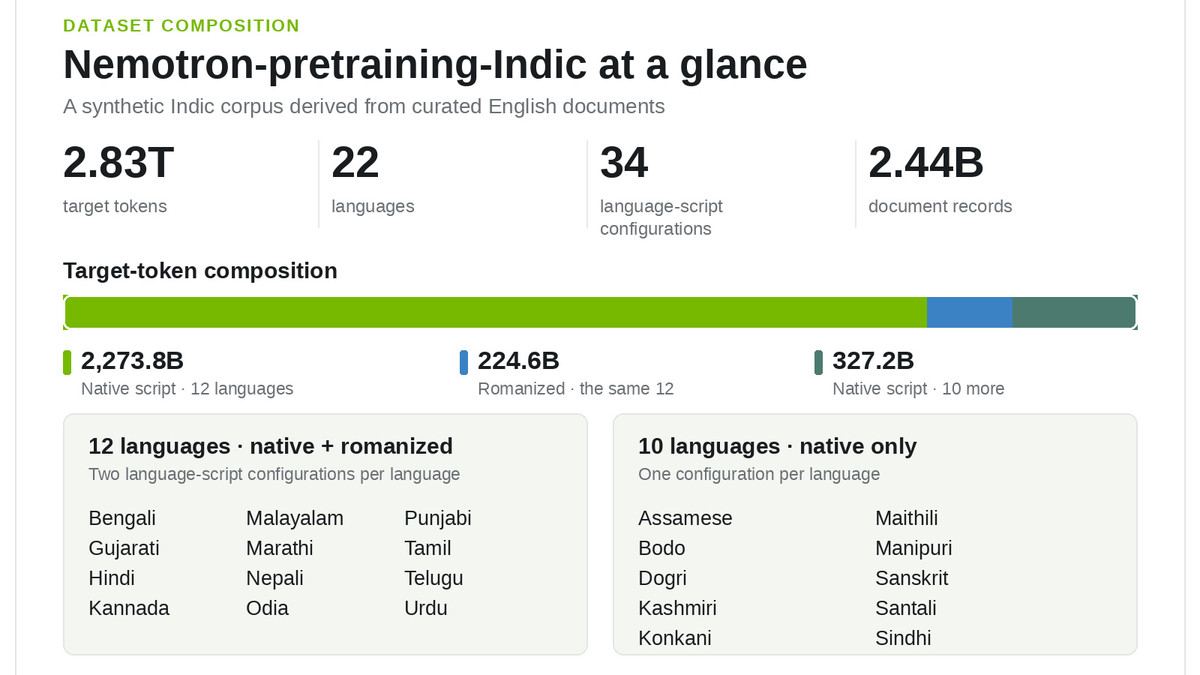
Nvidia says it will release “Nemotron-pretraining-Indic-v1,” a set of AI training data covering 22 Indian languages. The dataset was built together with IIT Madras and AI4Bharat, a lab housed there. It runs to roughly 2.8 trillion tokens. Nvidia says it will also release the tools and the step-by-step pipeline used to build it.
What’s in the data
The core of the dataset is English-language math, code, and question-and-answer material translated into Indian languages. Nvidia says it expanded the pool of training material so that models can explain technical concepts, work through problems, and answer questions in these languages. The scope covers the 22 languages recognized in India’s constitution. Based on the 2011 census, 97% of Indians, roughly 1.2 billion people, speak one of them as a first language.
All 22 languages are represented in their native scripts. For 12 of them, including Hindi and Tamil, Nvidia also added romanized material: Indian-language text transcribed in Latin characters. Because multiple languages and script forms are generated from the same source text, the total token count includes records that overlap in content.
How translation quality was filtered
The team designed the pipeline to translate whole documents while leaving code, formulas, and tables in their original form. For 12 languages, translation and quality scoring were both handled by Gemma-4-31B-it. Only output scoring 75 or higher out of 100 was kept; anything below the bar had its errors corrected and was then scored again.
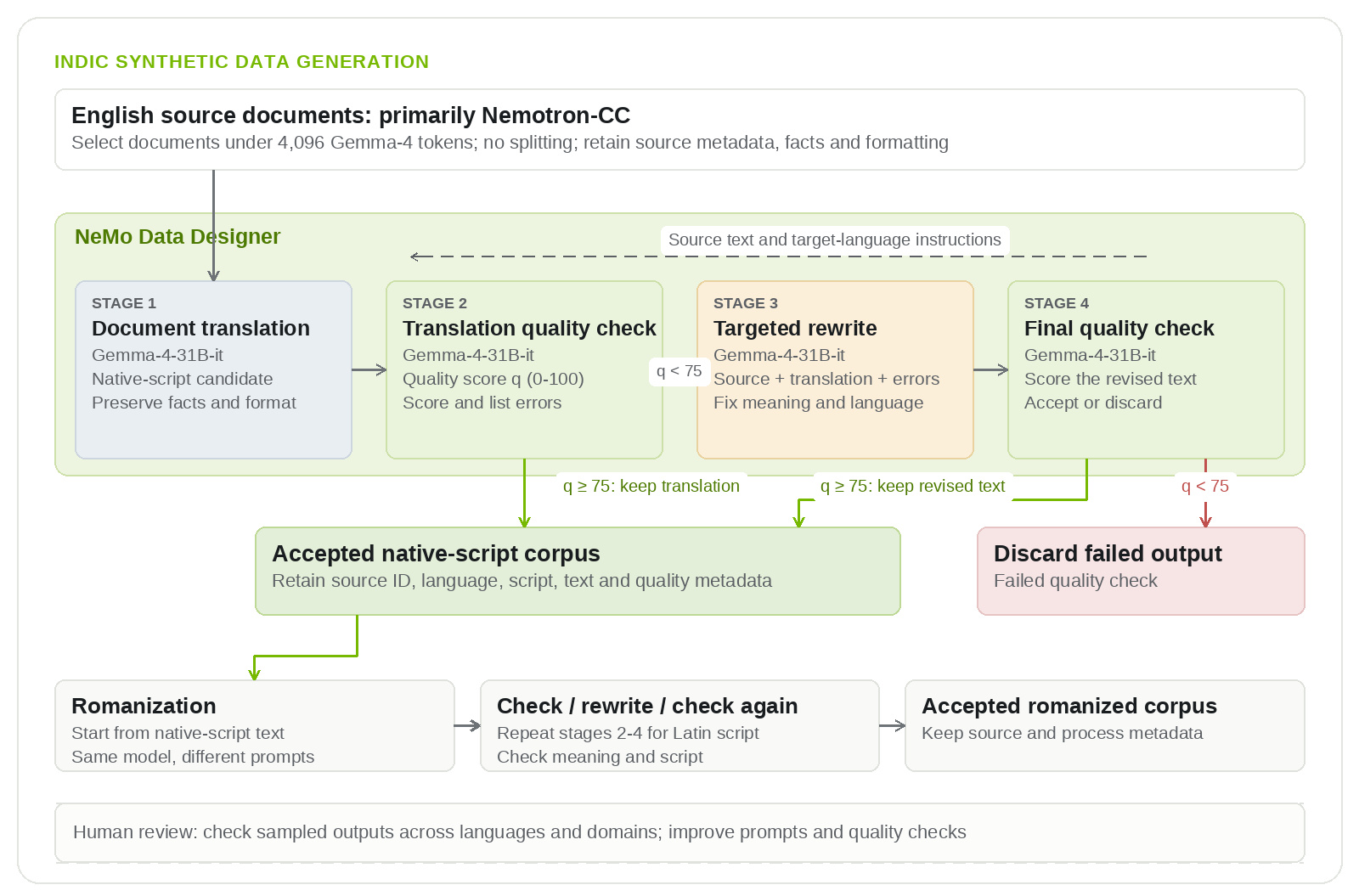
Image: huggingface.co
The remaining 10 languages were handled with Indic Translate, a document translation model from Bodhan AI. For long documents, such as those in Santali, the text was split, translated, and then stitched back together, one example of how the pipeline was adjusted language by language. Each output carries an identifier that traces it back to its source text. Developers will be able to feed their own source material into the pipeline once it is released, or change the quality-check thresholds.
Did model performance improve?
When Nemotron 3.5 Super VL was given additional training, the 12-language portion of this dataset was used alongside human-written Indian-language material. Together, that material accounted for 10 billion of the 100 billion tokens in the additional training run, or 10%. Comparing before and after this stage, Nvidia says scores rose on all five benchmarks measuring knowledge and reasoning, with gains ranging from 4.98 to 9.82 percentage points.
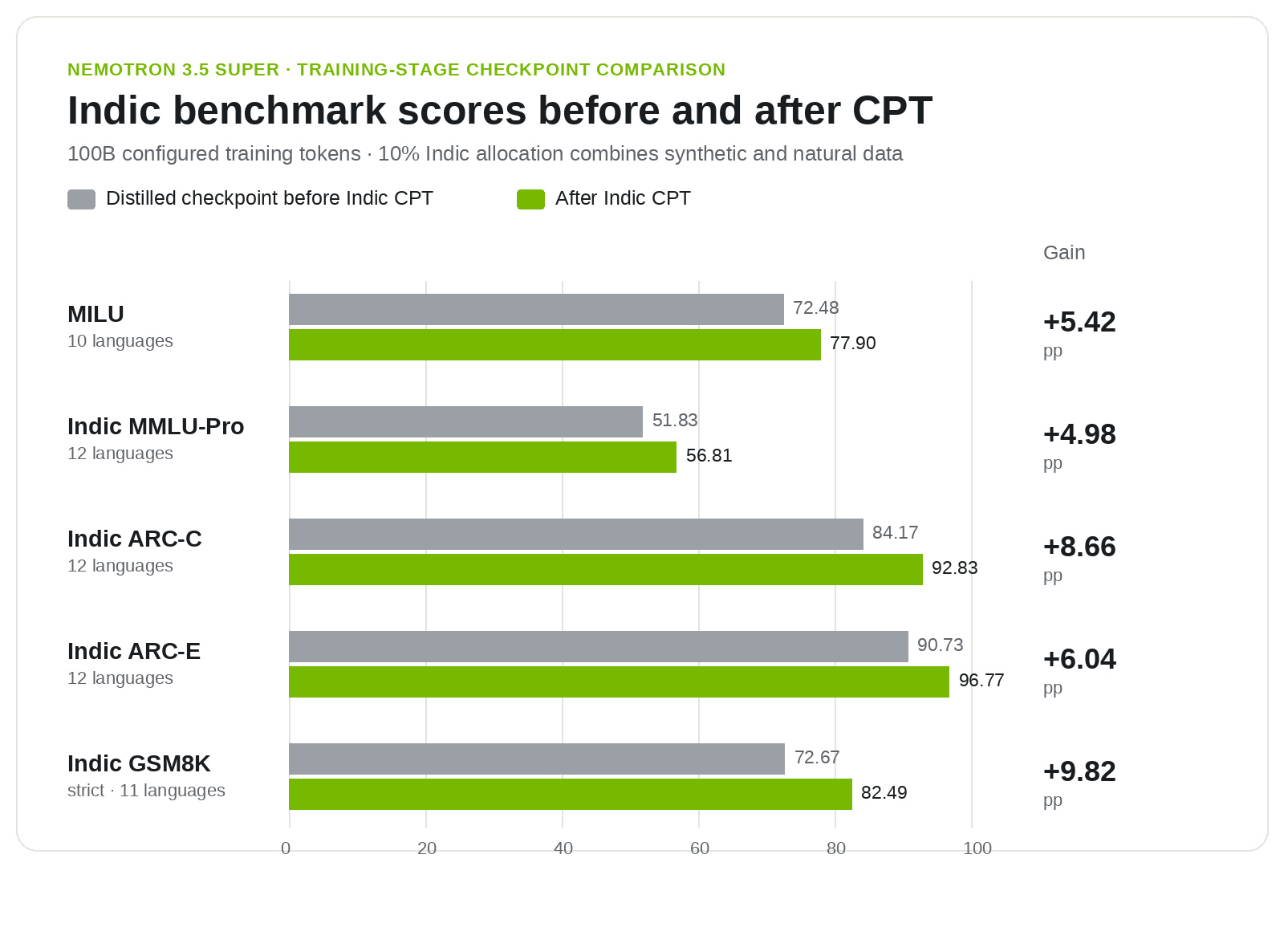
Image: huggingface.co
Against the previous generation, Nemotron 3 Super, scores improved on five of six task benchmarks. On IFEval 1.5, which measures instruction-following ability, the score fell by 2.04 points.
The immediate audience for this dataset is teams building AI for Indian languages. Once it is out, users will be able to preview a subset of records on Hugging Face without downloading the whole thing. Nvidia stressed that human-written material in local languages remains essential for capturing regional knowledge and cultural context. How much machine-generated material to mix in for best results, and how the full dataset performs once corrected translations and the remaining 10 languages are included, are still open questions.