SK Telecom Wins International Award for 5G Tech That Moves Finished Cars Without Drivers
Base stations use AI to work out where a vehicle should go, and the company demonstrated driverless parking. A pilot at a Korean auto plant is planned for 2027.
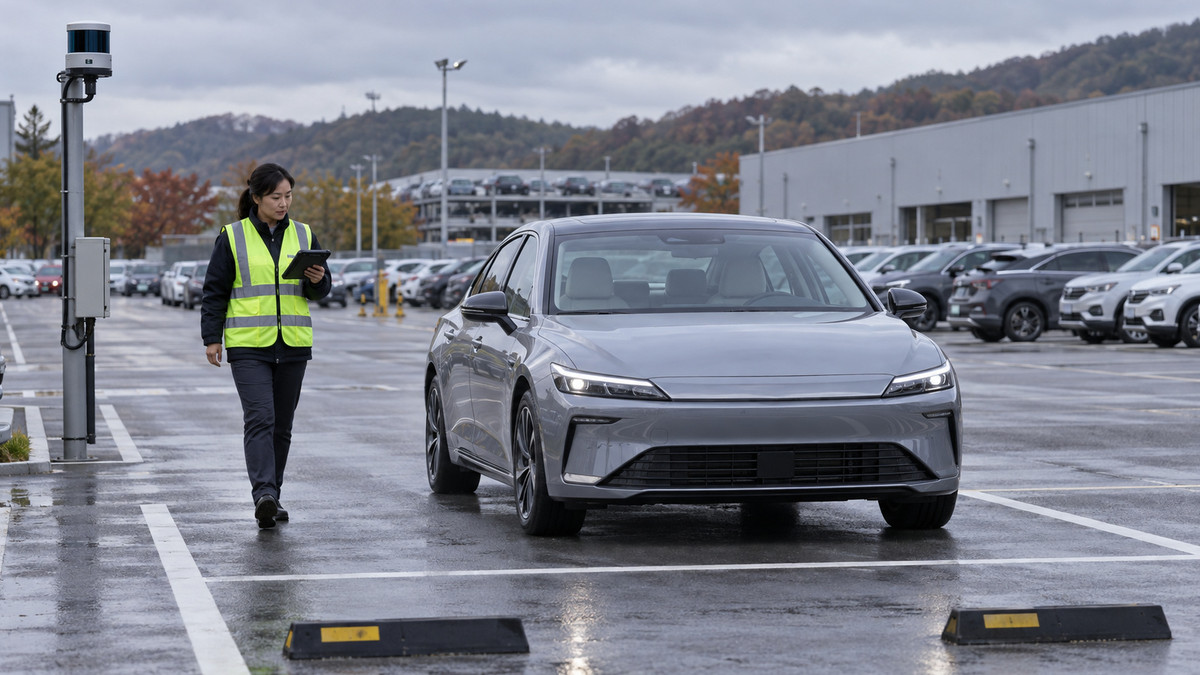
SK Telecom has won an international award for technology that moves finished vehicles without a driver, using AI and a 5G network. On October 15, the company announced that it had won the “Most Innovative 5G Communication Service” award at the Network X Awards, held in Vienna, Austria, on October 14 local time. The winning technology is called “AI-RAN-based Autonomous Vehicle Marshalling (AVM)” for finished vehicles.
Network X is an international telecom networking event organized by Informa. The award category recognizes telecom services that build new services and business models on top of 5G. SK Telecom said it was recognized for creating a service in which the network itself identifies and controls vehicles on site.
How do you move a car that has no self-driving system?
The approach is that the telecom base station takes over the decision-making that would normally have to happen inside the car. AI-RAN refers to base station equipment that processes communications and AI workloads together. SK Telecom said that in tests of the base station it developed, network quality held steady even while AI workloads were running alongside.
A vehicle’s position and its surroundings are tracked by lidar sensors installed at the site. The lidar sends three-dimensional data capturing the shape and location of objects, and the base station reconstructs the scene in a virtual space. It then calculates a collision-free route and issues driving commands. According to SK Telecom, even an ordinary vehicle with no self-driving capability can be moved without a driver once the necessary hardware and software are installed.
What did the real-world parking test show?
SK Telecom tested the technology at an actual parking facility, having vehicles drive themselves into parking spots. According to the company, the full loop, gathering sensor data, having the AI make a decision, and sending driving commands, was completed within the time budget required to control a driverless vehicle. The demonstration vehicle finished parking without anyone touching the controls.
The target application is the movement of finished vehicles, a job that until now has required people to drive each car themselves. SK Telecom said the test confirmed the potential to extend automation to ordinary vehicles and robots as well. It also said that because the network monitors the entire site and coordinates routes, it can head off the congestion that occurs when vehicles get tangled up in narrow lanes.
When does this reach Korean factories?
The target date for deployment at industrial sites in Korea is 2027. Under a government-funded project called “Building the Foundation for a Hyper-AI Network,” SK Telecom plans to apply and validate the technology at a domestic auto plant. From there, it aims to expand to large-scale logistics sites such as ports and airports. At the commercial stage, the company said it could manage the movement of multiple vehicles on top of 5G equipment it has already deployed, and run a subscription business model with pricing based on scale.
Ultimately, the change this technology is aiming for is the automation of moving cars around factories and logistics sites. In the upcoming pilot at a Korean auto plant, the key question will be whether vehicle movement and communications can be handled together, reliably, in a real working environment.