SK Telecom Drops "Coding" From Its AI Contest for Students With Disabilities as 110 Compete
What used to be a coding competition is now a contest about expressing ideas and solving problems with AI. Participants made posters and videos with AI tools, and tried augmented reality and drone simulations on the side.
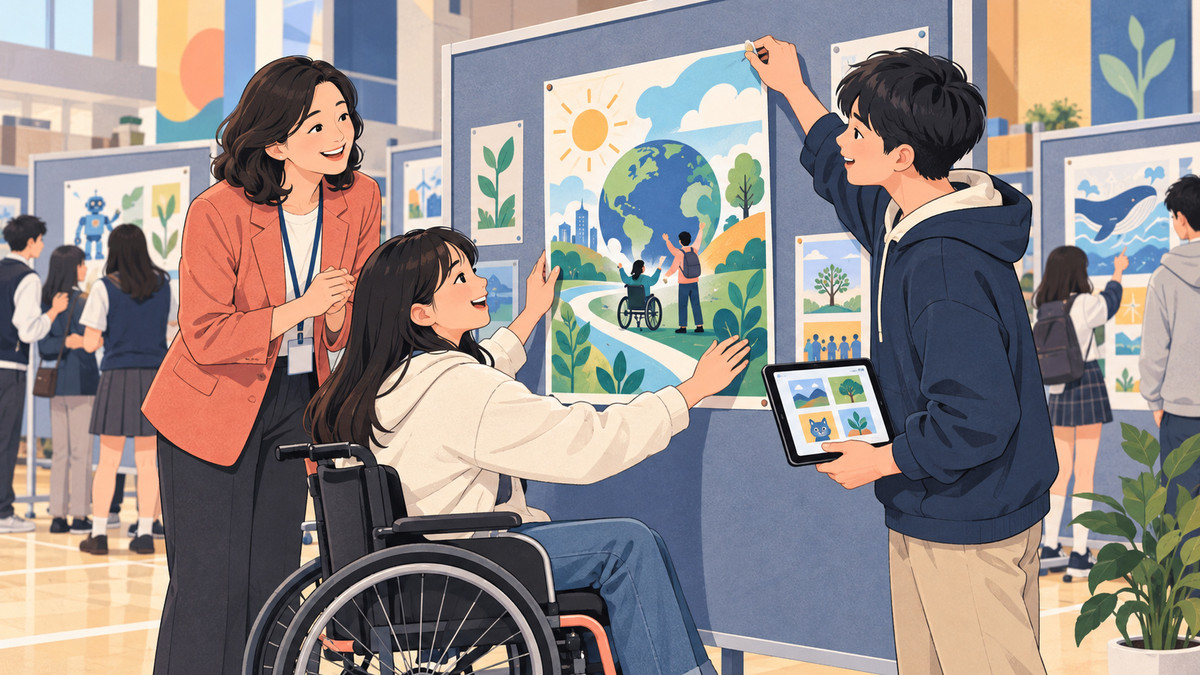
SK Telecom says it has held the “2026 Happy AI Challenge,” a competition testing how well students with disabilities can put AI to use. The event ran from October 14 to 15 at the SKT Institute for Talent Development in Icheon, Gyeonggi Province. A total of 110 students with disabilities and 44 supervising teachers took part, solving assigned tasks and producing creative work with AI.
Why the contest dropped “coding” from its name
Now in its 27th edition, the contest changed both its name and what participants actually do. The former “Happy AI Coding Challenge” became simply the “Happy AI Challenge,” with the focus shifted to solving problems using AI. SK Telecom’s digital education work for students with disabilities dates back to 1999, when it launched an information search competition.
On the first day, participants worked in pairs through a series of tasks. They answered AI ethics quizzes, mapped out routes for a robot to travel, and searched for information on cultural heritage. Finding a password using a QR code was also among the tasks.
Another task asked students to express their own ideas as images and video. Using AI tools such as SK Telecom’s A. (A dot), the participants produced posters and videos on assigned themes. In other words, the contest no longer measured coding skill alone; it also assessed the creativity that went into making the work.
What else was on offer
Alongside the competitive tasks, the organizers set up hands-on sessions with digital technology. Participants tried augmented reality (AR) racing, which overlays virtual elements on a live view of the real world, as well as drone simulations. They also took part in coding activities using LEGO robots. To help shake off the tension built up while preparing for the contest, there was time set aside for music and for cheering one another on.
A teacher at the event said students had changed over the preparation period. “As they got ready for the contest, the kids gained confidence in using AI and also got over their fear of trying something new,” said Jang Ji-hyun, a teacher at Mudeung Middle School. Jang also pledged to support the students in entering the next contest, so they could build on the experience.
The Minister of Science and ICT Award went to Kim Yun-gyu and Lee Eun-hui of Chungju Sungsim School. The Minister of Education Award went to Jeon Jun-eon and Jeong Yong-su of Yeongju Jeil High School. The Minister of Health and Welfare Award went to Yun Hyeon and Lee Da-bin of Jeonbuk Pureun School.
After the contest
Beyond the competition, SK Telecom runs school programs and career exploration activities. Since 2019 it has operated the “Happy AI Coding School,” delivering coding and AI education at roughly 570 schools nationwide. In September, it invited winners from last year’s contest to a program where they explored career paths and tried out AI technology.
Eom Jong-hwan, head of SK Telecom’s sustainability management office, said the significance of the event lay in young people using AI to express their own ideas and solve problems. The company said it will continue working to narrow the digital divide and widen opportunities for growth through AI. The next question is how these education and hands-on opportunities carry over into everyday classrooms.