Liquid AI Unveils LFM2.5, a Tool-Using Model for Your Own Device
LFM2.5-24B-A2B reads more text at once than its predecessor and is built around tool use and instruction following. The model files can be downloaded and run on personal hardware.
Liquid AI released LFM2.5-24B-A2B on October 13 local time, a model aimed at AI agents that handle tasks on their own, running on personal devices. The company posted both a ready-to-use model and a Base model that serves as a starting point for further training on Hugging Face. Users can download the model and run it on their own hardware, or fine-tune it for their particular work.
How much more can it read at once?
The new model keeps the basic architecture of its predecessor, LFM2-24B-A2B, while expanding how much text it can take in at one time. Measured in tokens, the chunks of text a model processes, the earlier version handled 32,000; the new one handles roughly 131,000. The wider reading window is meant for tasks that involve consulting long documents.
The way it produces answers has changed as well. The new model writes out its reasoning before delivering a final answer, and at each step only a portion of the full model is active. Liquid AI says this approach cuts the computational cost of the reasoning process. Training drew on mathematics, code, instruction following and text in multiple languages, and it also included sequences in which the model calls tools and carries a task through several turns.
Does it handle tool use better than bigger models?
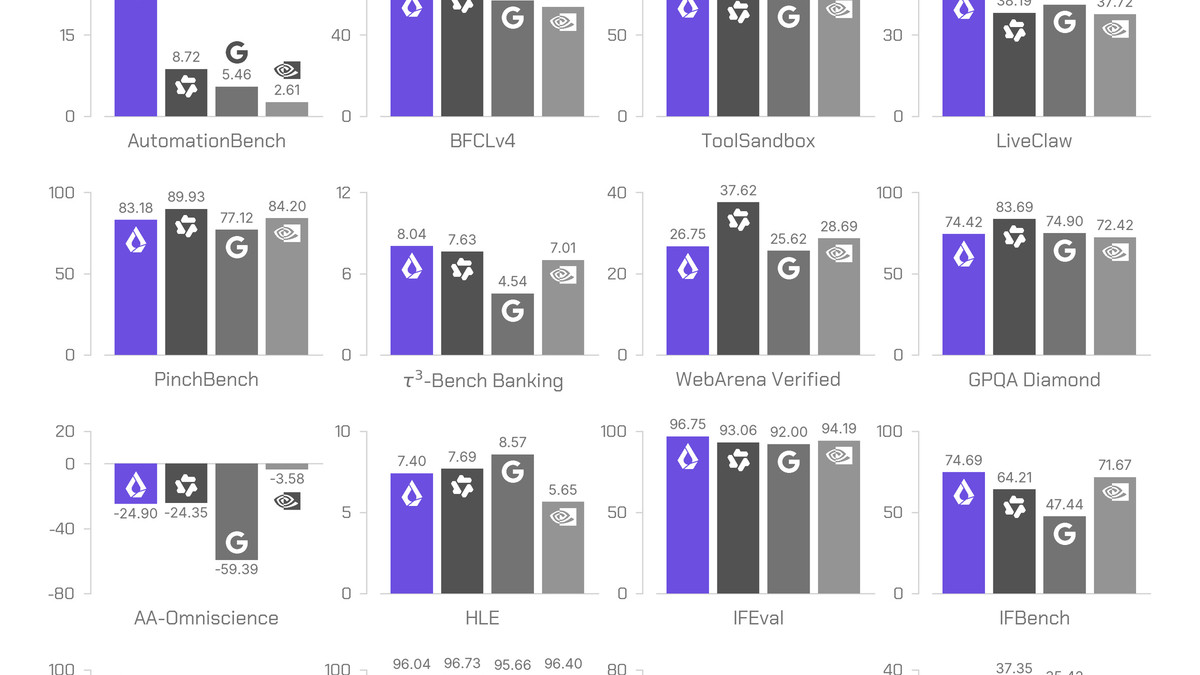
Liquid AI compared the model against rivals across 16 performance tests spanning tool use, knowledge, math and coding. The comparison models were Qwen3.6-35B-A3B, Gemma-4-26B-A4B-it and Nemotron-3.5-Lightning. The company says it applied the response generation settings recommended for each test.
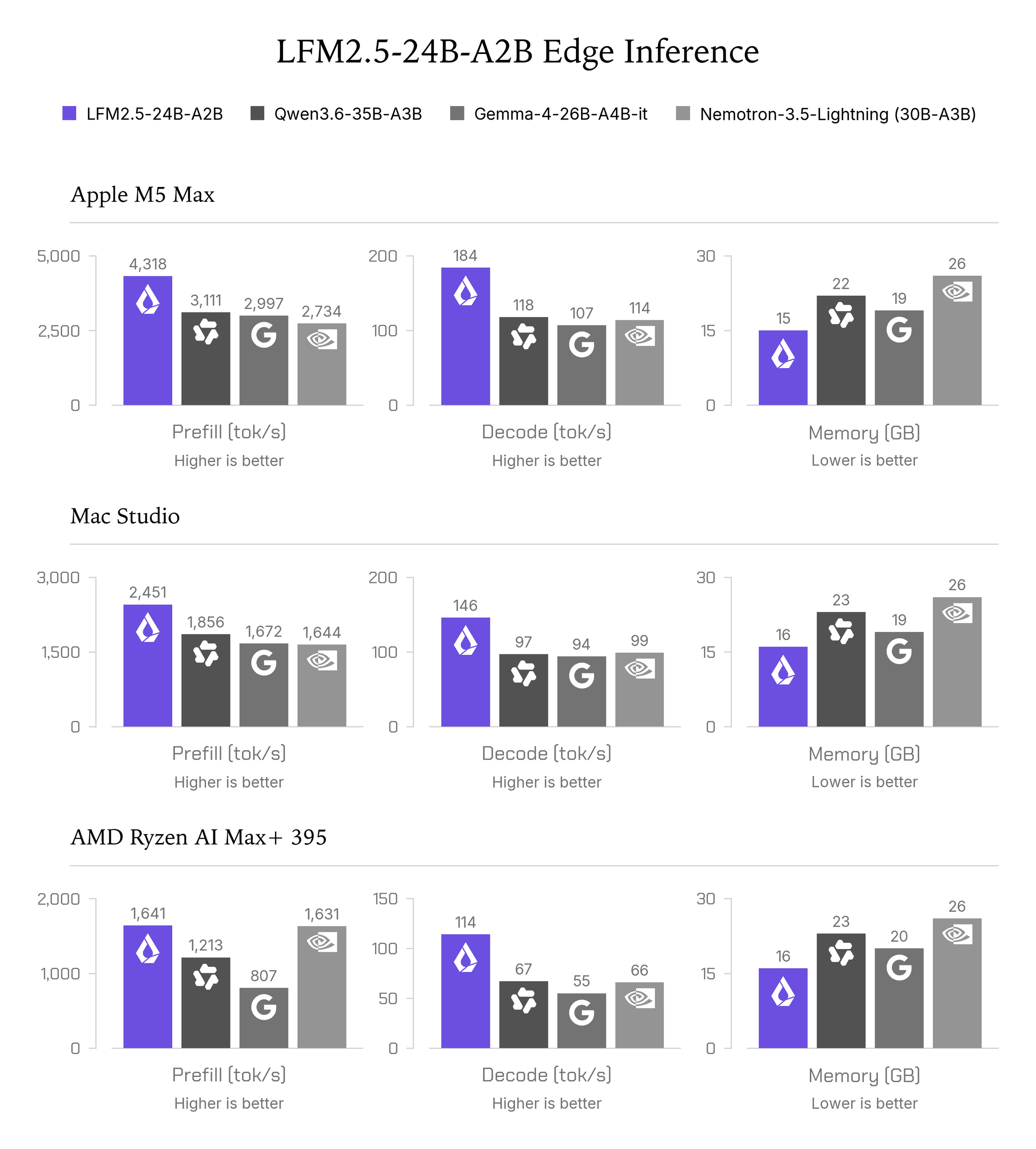
Image: huggingface.co
According to Liquid AI, LFM2.5-24B-A2B matched or beat the comparison models on five of eight tests related to tool use and agent behavior. Its LiveClaw score was 48.09, higher than the 38.19 posted by Qwen3.6-35B-A3B. It came out ahead on all three instruction-following tests. The company points to the model’s ability to pick the right tool and carry out a task based on what the user asks as its main strength.
In knowledge and coding there were areas where the larger models led. Liquid AI said bigger models scored better on knowledge-heavy tests such as GPQA Diamond and coding tests such as SWE-Bench Verified. For knowledge-intensive work, it recommended pairing the model with document retrieval or web search.
How fast is it on my own device?
Liquid AI reported generation speeds of 184 tokens per second on an Apple M5 Max and 114 tokens per second on a Ryzen AI Max+ 395. That makes it up to 1.7 times faster than the next-fastest model in the comparison set, the company says, with the lowest memory footprint as well.
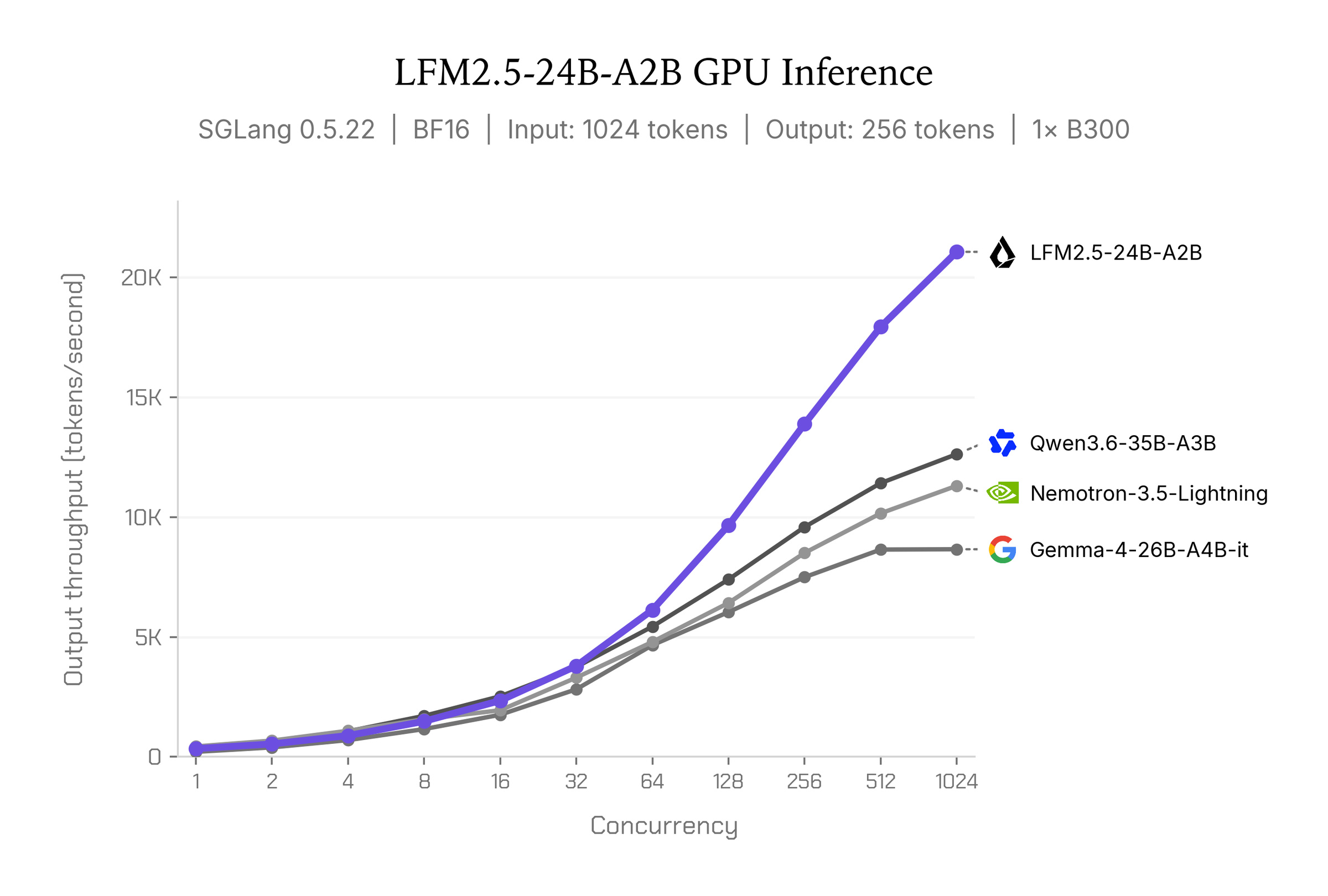
Image: huggingface.co
In settings where many requests are handled at once, the company says a single Nvidia B300 produced more than 21,000 tokens per second. The model supports several model-running tools from day one, and Liquid AI also published instructions for launching it on a device and connecting it to task-oriented programs such as Hermes Agent.
This release adds one more model that anyone can download and wire into tool-use workflows. Korean users will want to check first how well it follows instructions in Korean and whether it runs comfortably within the memory their hardware has available. Adoption is a decision to make after reviewing the company’s own speed measurements along with Korean-language performance, hardware requirements and terms of use.