SK Telecom Revives 1914 Malmoi Handwriting With AI, Releases It as a Free Font
A Hangeul Day campaign film, "2026 Malmoi," shows the company's A.X K2 model analyzing a 1914 dictionary manuscript. The resulting "Malmoi" typeface, covering 2,350 Hangeul characters, is free for anyone to download.
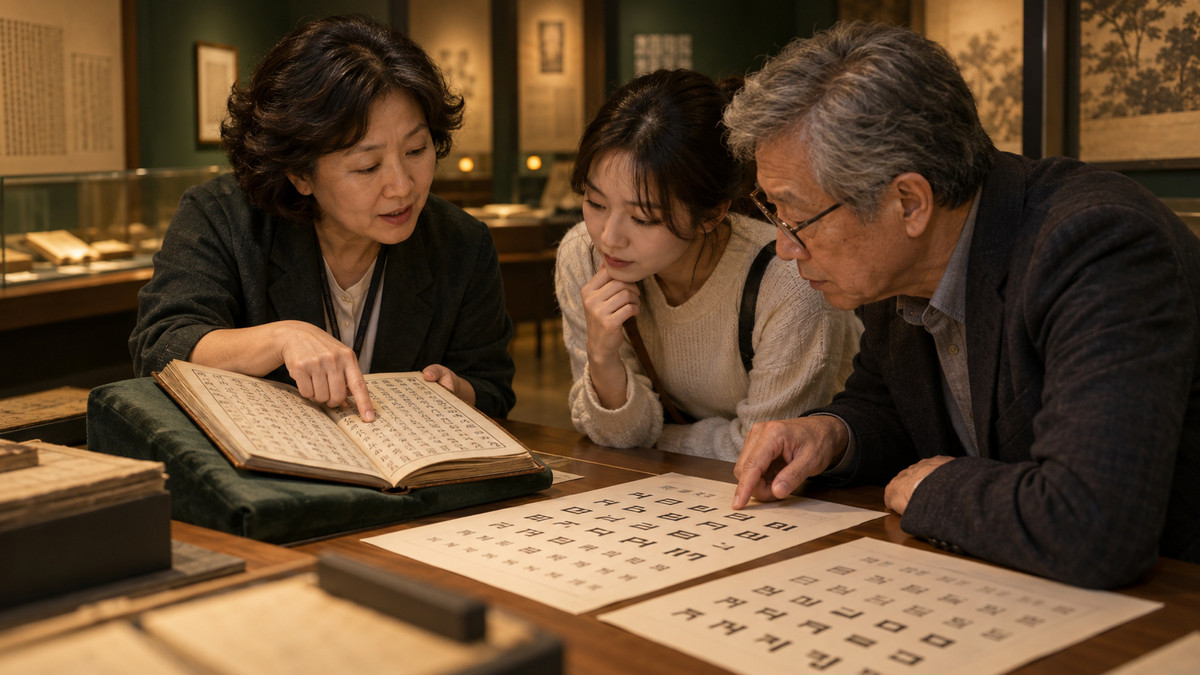
For this year’s Hangeul Day, the Korean holiday commemorating the proclamation of the Korean alphabet, SK Telecom has released a campaign film titled “2026 Malmoi.” The roughly four-minute video documents how the company used its own AI model, A.X K2, to analyze the 1914 manuscript of “Malmoi” (literally “a gathering of words”), turn its handwriting into a digital typeface, and select native Korean words to compile into a book. Actor Kim Dae-myung provided the narration. The National Institute of Korean Language and the National Hangeul Museum also took part.
How a 1914 dictionary manuscript became a typeface
“Malmoi” is the manuscript of a Korean-language dictionary that the linguist Ju Si-gyeong and his students began compiling in 1911 at the Joseon Gwangmunhoe. Work halted after Ju’s death, and the dictionary was never finished. What survives today at the National Hangeul Museum is a single volume written in 1914. Containing a set of explanatory notes called “Algi,” the main entries, a “Chatgi” index, and a stroke-based index, the manuscript was designated a Treasure in 2020.
The project began by converting the manuscript into data, then analyzing the shapes of the handwriting. SK Telecom says A.X K2 identified features shared across the strokes and characters in the manuscript and organized them into consonants and vowels. Expanding those elements into thousands of character combinations produced the result: the “Malmoi” typeface. The company says A.X K2 was designed with Korean as the starting point of its training, giving it particular strength in understanding Korean context and culture.
The Malmoi typeface is free for anyone to download
The Malmoi typeface supports 2,350 precomposed Hangeul characters and comes in three weights: light, regular, and bold. SK Telecom says it is being released as an open font that anyone can download and use. Handwriting preserved in a museum can now be chosen as a font for documents and messages. SK Telecom has also applied the Malmoi typeface to the newsroom content introducing the campaign.
Alongside the typeface, the project also involved selecting native Korean words, those of purely Korean origin rather than Chinese or other loanwords. A.X K2 analyzed the National Institute of Korean Language’s “Standard Korean Dictionary” and “Urimalsaem,” a crowdsourced Korean dictionary built with public participation, to pick 100 native Korean words. Among them is “yunseul,” meaning ripples glittering in sunlight or moonlight. Also chosen were “eungyeol,” waves that appear silvery white in the moonlight, and “neoul-neoul,” describing the slow billowing of cloth or leaves.
Each selected word was annotated with its part of speech and definition and arranged like a dictionary entry. Below each word set in the Malmoi typeface, its consonants and vowels were broken out one by one. Printed and bound, the result is the book “100 Beautiful Native Korean Words Gathered by Artificial Intelligence.” The book will be donated to the National Hangeul Museum.
Voices from a century ago also appear in the film
The film covers not only handwriting but also the voices that preserved the Korean language. It opens with a recording of Yi Geuk-ro explaining the Korean language, made in Paris in 1928. That record is held at the National Library of France. The film also includes an AI-generated reconstruction of the Malmoi compilation work and records related to Gagya Day. The first Gagya Day ceremony was held in 1926, making this year the 100th anniversary of the observance. The name was changed to Hangeul Day in 1928.
Park Mi-young, a curatorial researcher in the Language Information Division of the National Institute of Korean Language, said that even as the tools of record keeping expand into digital technology and AI, the purpose of passing the Korean language on to the next generation remains the same. Reviving the handwriting of an old manuscript as a usable typeface, and selecting words from the dictionary to preserve once again, is the heart of this campaign.