Falcon-Emirati-7B Released: Ask in Emirati Dialect, Get an Answer in Kind
A new AI model tuned to the dialect and culture of the United Arab Emirates has been released. By the development team's own measurements, it outperformed comparison models both at picking correct answers and at replying in dialect.
On October 6, the Falcon development team released Falcon-Emirati-7B, an AI model specialized in the dialect of the United Arab Emirates (UAE). Built on the existing Arabic model Falcon-H1-Arabic, it received additional training on local vocabulary, grammar, and cultural knowledge. According to the team, the model is designed to grasp meanings that get lost in word-for-word translation, from everyday conversation to proverbs and poetry, and to respond in the local register.
How It Differs From Standard Arabic
The problem the team set out to solve is the gap between written and spoken Arabic. News and textbooks use Modern Standard Arabic. Daily conversation in the UAE, by contrast, uses Emirati dialect, with its own vocabulary and rhythm. The team explained that for expressions where cultural context matters, such as proverbs or Nabati poetry, knowing what the individual words mean is not enough to catch the actual meaning.
The new model is built on the 7-billion-parameter member of the existing model family. That base model had already been trained on Standard Arabic, several regional dialects, English, and multilingual data. The team then taught it Emirati dialect intensively. As the reason for choosing the 7-billion-parameter size, the team cited the balance between having enough capacity to absorb the fine distinctions of a dialect and keeping training and inference costs manageable.
How They Taught It the Local Register
Training combined real dialect text, cultural material, and AI-generated data. Naturally occurring dialect was collected from local websites and forums. Standard Arabic sources covering customs and history filled in cultural knowledge. Generated data, created to broaden the range of conversation topics, was constrained by an Emirati vocabulary dictionary and grammar rules. The team explained that these constraints were imposed to keep the output from blending into other Gulf regional registers.
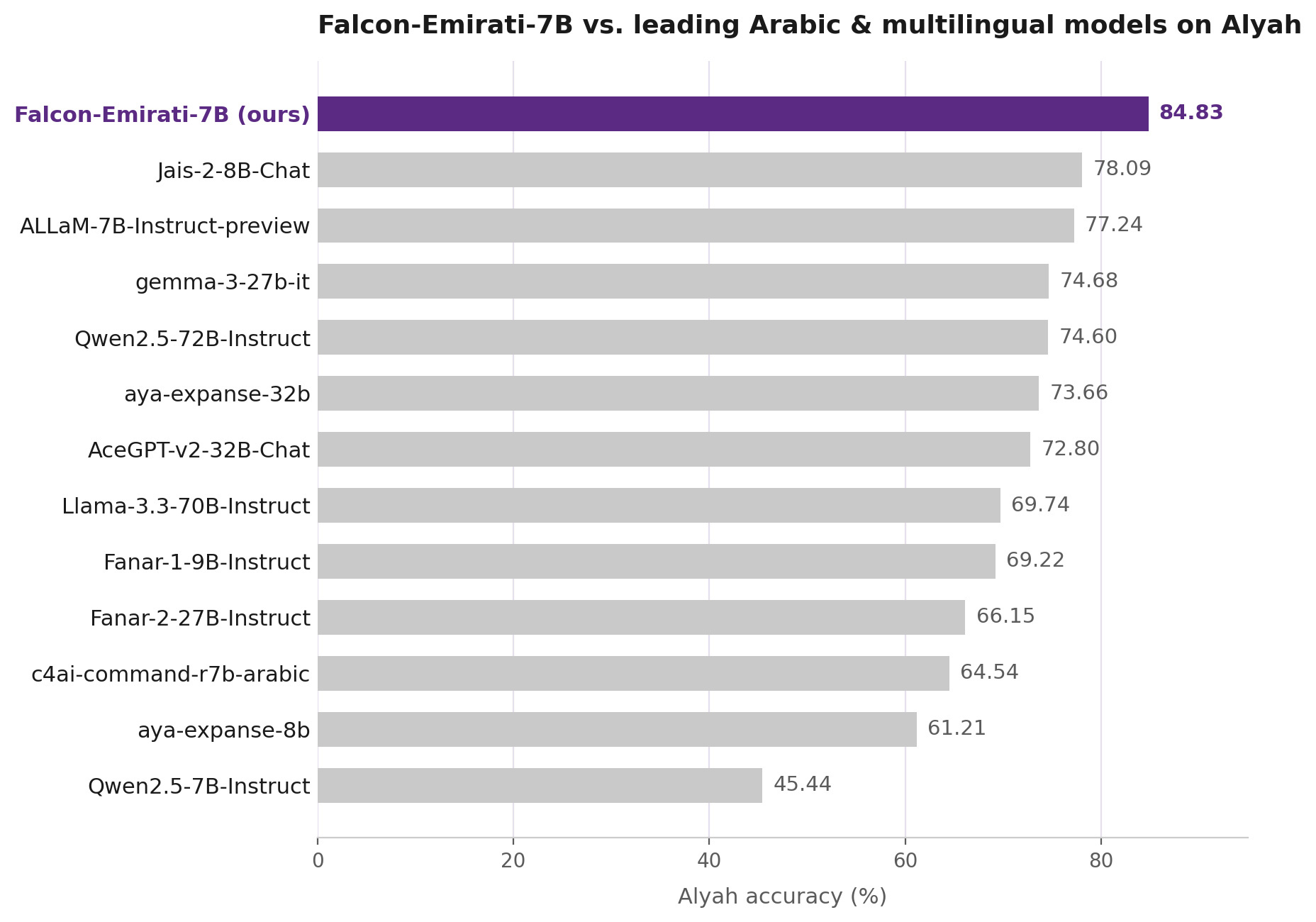
Image: huggingface.co
Training results were checked using both automated scoring and native speaker review. Native speakers assessed not only factual accuracy but also how natural the register sounded and whether it was culturally appropriate. For numerical comparison, the team used Alyah, a performance test built jointly by the team and the community. It consists of 1,173 multiple-choice questions hand-collected from native speakers, covering greetings and etiquette, figurative expressions, traditional knowledge, and poetry.
So Does It Actually Answer in the Local Register?
Falcon-Emirati-7B scored 84.83% on Alyah. The team said this was the highest result among the Arabic and multilingual models compared. The Falcon-H1-Arabic family, which serves as the base model, was excluded from that comparison. The team also ran an evaluation in which models answered the same questions in free-form text.
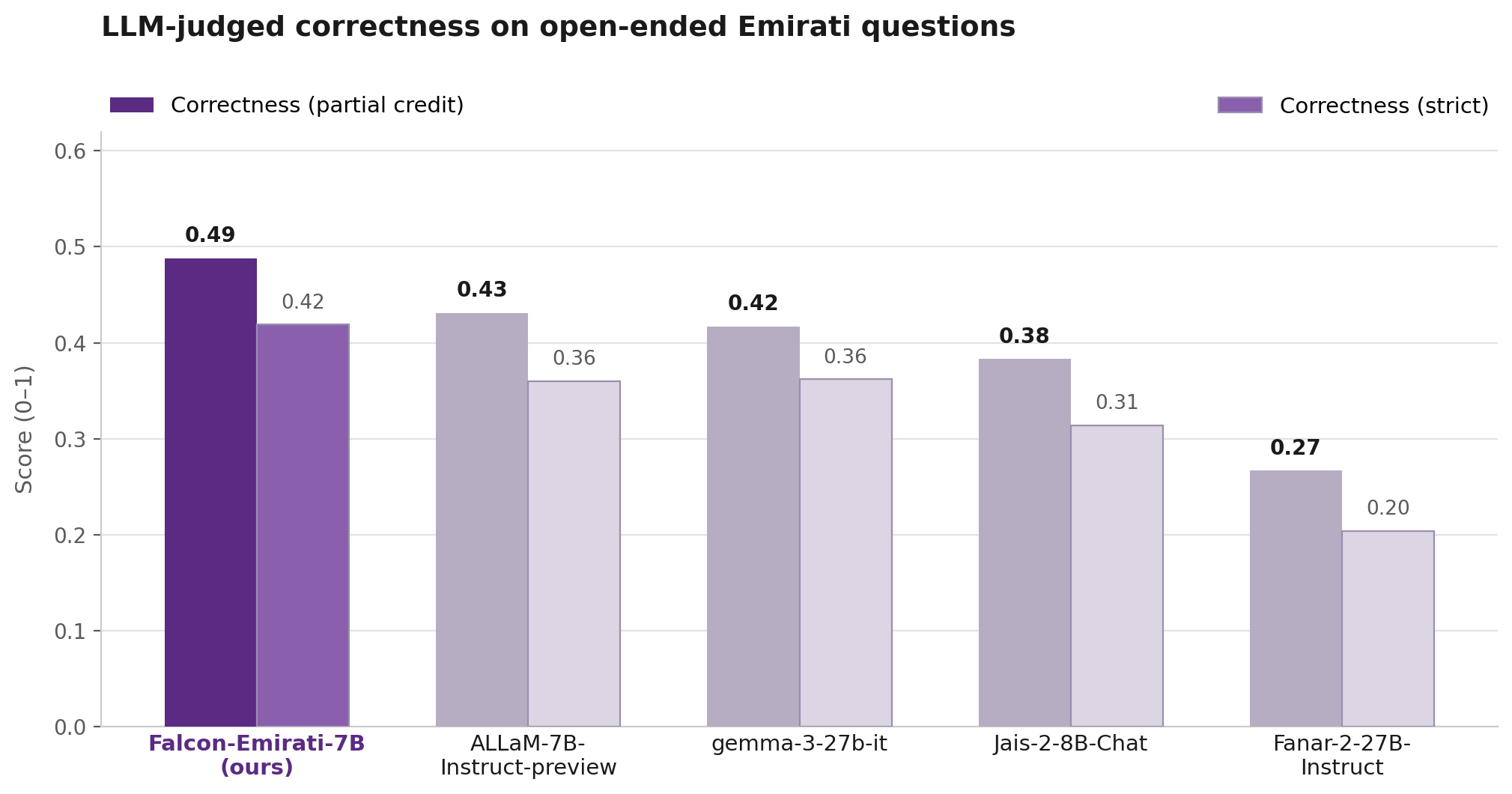
Image: huggingface.co
Free-form answers were graded by Gemini 3.7 Flash on content accuracy and degree of dialect use, scored separately. In the partial scores the team published, Falcon-Emirati-7B ranked highest on dialect use at 0.52. Among the comparison models, ALLaM scored 0.05, gemma-3-27b-it 0.03, and Jais-2-8B-Chat 0.02, while Fanar-2-27B-Instruct came in at effectively 0.00. The team explained that the comparison models tended to answer in Standard Arabic even when asked in Emirati dialect.
The shift this model is aiming for is an experience where users ask in the way they normally speak and get an answer back in the same register. That makes it worth a look for Korean companies preparing services that will converse with UAE users. The remaining hurdle is whether scores from a multiple-choice test carry over into real everyday conversation.