NASA and IBM Release a Lunar Research AI That Spots Craters and Estimates Where Ice May Exist
The model was trained on 17 years of observations from the Lunar Reconnaissance Orbiter, and it is open source for anyone to download. IBM says polar ice prediction error fell by as much as 22% against comparison models.
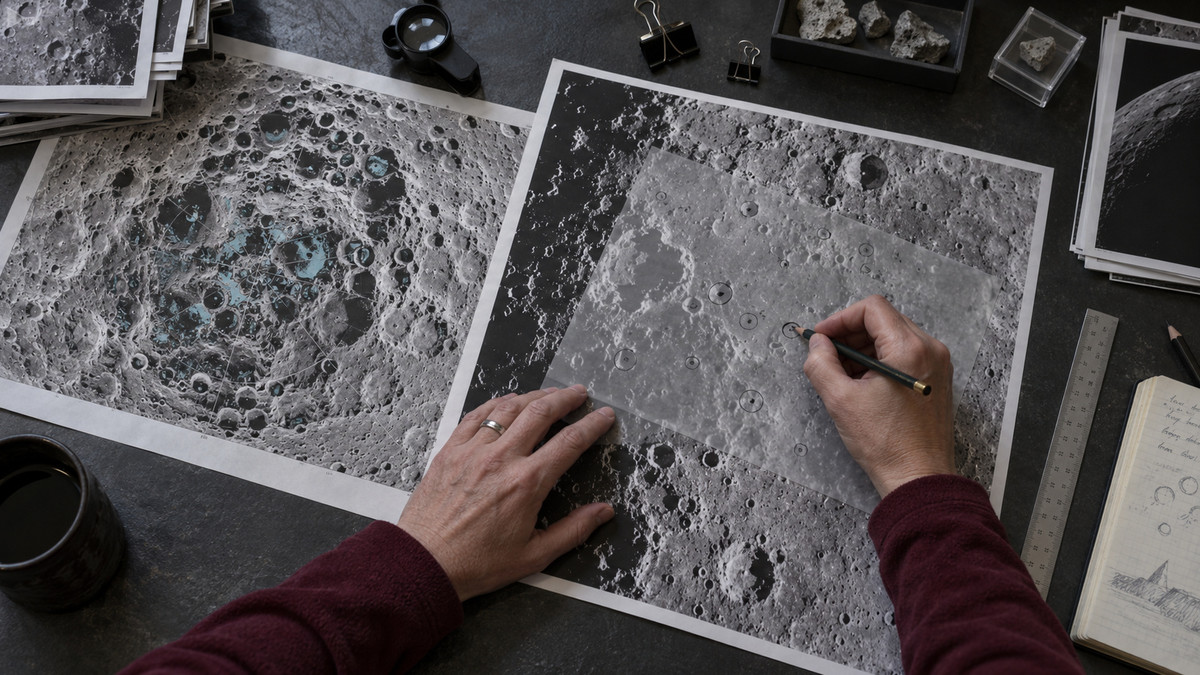
NASA and IBM released an AI model for studying the lunar surface on September 10 local time, called the NASA-IBM Lunar Foundation Model. It is an open-source model trained mainly on 17 years of observations gathered by the Lunar Reconnaissance Orbiter (LRO). Researchers can use it to locate impact craters or distinguish volcanic terrain. It also estimates the likelihood that ice is present at the poles.
What changes in lunar image analysis
The biggest shift is that a single model can be reused across many different research tasks. Until now, researchers either inspected imagery by hand or built a separate model for each task. This model has been pre-trained on a wide range of observational data. Researchers can fine-tune it on a small amount of labeled data tailored to their research goal, then use it for that specific analysis.
Training used roughly 2 million small tiles cropped from wide observational images. That included more than 1 million images from a 1 m resolution camera and about 964,000 multispectral images at 100 m resolution. Multispectral images capture light separated into several wavelength bands. Data from other US and Japanese exploration missions was also used.
Prithvi, released earlier by NASA and IBM, handled Earth observation data, while Surya covered solar observations. This time the pair built a foundation for reusing lunar observation data across multiple kinds of analysis. A notable feature is that the model was trained on observational data of differing resolutions and types all at once.
How much more accurate is polar ice prediction
IBM said that in comparative experiments estimating the likelihood of ice at the poles, error dropped by as much as 22%. That figure is measured against the highest-performing model among the comparison set. The evaluation used image analysis AI models including SwinV2-B.
In crater detection tests, performance improved even when the amount of training data was reduced. According to IBM, when finding craters in 100 m resolution imagery, the model scored about 19% higher than the comparison model while using only half the training data. NASA noted that how visible a small crater is can vary depending on the lighting conditions at the time of imaging.
Can researchers in Korea use it
Researchers in Korea can download and use the model from Hugging Face. The trained model files and evaluation datasets were released alongside it. GitHub hosts code for fine-tuning the model to specific tasks and for running analyses. Code for training the model from scratch, however, was not included.
The most direct beneficiaries of this release are researchers who analyze lunar observation data. They can now adapt a shared pre-trained model to their own purposes. The remaining question is whether the performance gains seen in these tests carry over to research with different observing conditions and different analysis targets. In particular, how reliably the model can find small craters, whose visibility shifts with lighting, will be the benchmark for judging how broadly it can be applied.