GPT-6 Astra Ultrafast Arrives, Writing Answers Up to 8x Faster
Nvidia says GPT-6 Astra Ultrafast, running on Blackwell GPUs, writes text up to eight times faster than Standard mode. It is available through the developer API and to eligible ChatGPT Work and Codex users.
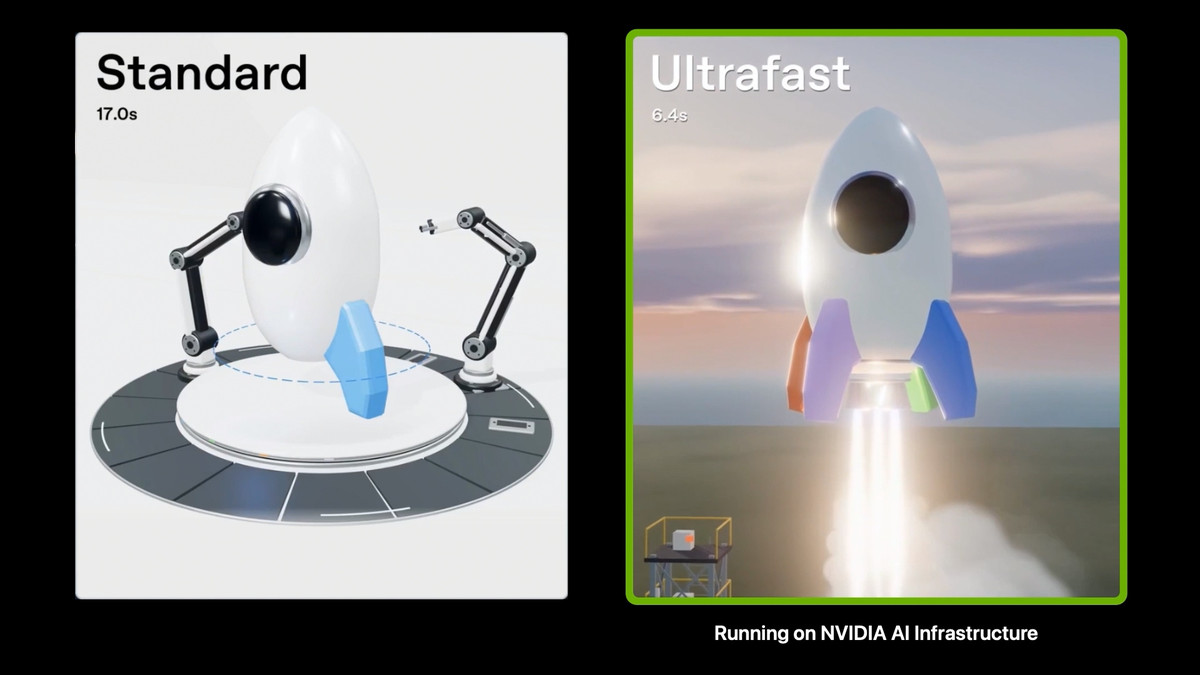
Nvidia has detailed the technology behind faster performance for OpenAI’s GPT-6 Astra Ultrafast, along with where it is available. Ultrafast runs on Nvidia’s Blackwell GPUs. It is accessible through the API, the route developers use to plug a model into their own services, and is also available to eligible ChatGPT Work and Codex users.
What exactly is up to 8x faster?
What got faster is the speed at which the AI writes out its answer. Nvidia says Ultrafast generates text up to eight times faster than Astra’s Standard mode. The company attributes this to software work that tailors how OpenAI’s models produce responses to the specific characteristics of Blackwell.
The speedup is aimed squarely at multi-step AI work. An agent, meaning AI that carries out tasks on its own, writes code, runs a tool, looks at the result, then decides what to do next. Nvidia explains that the more often text generation repeats inside that loop, the bigger the payoff from faster generation. The focus is not only on how long you wait for a single answer, but on trimming the dead time that piles up between steps of a task.
How much time comes off the code-and-test cycle?
For developers, the main use case is the cycle of editing code, testing it, and tracking down errors. Nvidia says faster generation can compress that loop. It also means less time spent producing text after the AI finishes using one tool and before it reaches for the next. The company added that the same gains can cut how long users wait for a reply in conversational apps.

Image: NVIDIA Blog
OpenAI’s own models were put to work on the acceleration effort. OpenAI says it used internal models to refine the software that generates responses on Nvidia GPUs. Uday Ruddarraju, OpenAI’s CTO of compute, said that being able to tune programs to Nvidia’s hardware contributed to Ultrafast’s speed gains.
The optimization work continues after a model ships. According to Nvidia, OpenAI is using its own models to test and roll out software improvements. Nvidia says this kind of work raises response speed while also squeezing more productivity out of hardware that is already running. Redeploying the same machines across different jobs, such as training and response generation, also makes it easier to respond to shifts in demand.
Who can use it
There are three paths to Ultrafast: the developer API, ChatGPT Work, and Codex. The API is available as of the announcement, while ChatGPT Work and Codex access is limited to eligible users. Nvidia directs readers to the Ultrafast guide for details on access, pricing, and how to switch it on. Developers adding the capability to a service and users adopting it as a work tool will each need to check which conditions apply to them.
The thing to watch from here is how much that headline figure of up to eight times faster text generation actually shaves off the time it takes to finish real work. For users in Korea, the deciding factors will be whether it is available locally, whether the speed holds up on Korean-language tasks, and what it costs.