Anthropic Ships Claude Sonnet 5.5: Same Price, 30% Faster
Anthropic says Sonnet 5.5 generates responses more than 30% faster than Sonnet 5, with per-task costs down as much as 30%. Prices stay put while coding and document performance climbs.
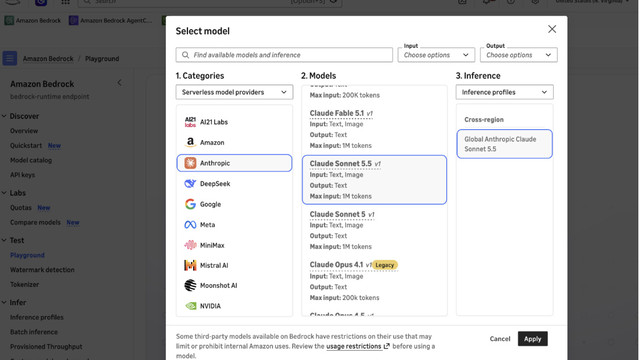
Anthropic released Claude Sonnet 5.5 on September 28. It is the second model in the Claude 5.5 family. The company says the model generates responses more than 30% faster than the previous Sonnet 5. It also burns through fewer tokens (the small chunks of text models read and write) to finish the same job. By Anthropic’s own measurements, that translates to a cost reduction of up to 30% per task.
What changed from Sonnet 5
The gains show up in coding and in document, slide, and spreadsheet work. On Terminal-Bench 4.0, the coding benchmark Anthropic published, the score jumped from 10.3% for Sonnet 5 to 70.6% for Sonnet 5.5. According to the company, early testers reported faster comprehension of codebases and better overall work efficiency.
Office-style tasks improved as well. On GDPval-AA, which assigns real work drawn from 44 occupations across nine major industries, the model scored roughly 400 points higher than Sonnet 5. In one internal test, Anthropic handed the model a public company’s quarterly earnings materials and earnings call transcript along with a slide template, then asked it to produce a 10-slide deck for an operational performance review. Two experts who reviewed the output judged that the first draft was good enough to send along as is.
Is it a substitute for Opus 5.5?
Anthropic says Sonnet 5.5 shines on clearly scoped day-to-day work and bug fixes. Its GDPval-AA score came in 2 points below Opus 5.5. The gap in best scores on CursorBench, which evaluates real coding tasks, was also about 2 points. That said, both the company and outside testers found Opus 5.5 better on complex, open-ended work.
Cost and results also shift depending on how long you let the model think. Anthropic says Sonnet 5.5’s cost advantage is largest when thinking time is kept short. Stretch it out, and performance converges with Opus 5.5, and so can the cost. The default setting is Medium in Claude Code and the app, and High on the Claude Platform.
Pricing and availability
For developers wiring it into their own products, the per-token rates are the same as Sonnet 5: $2 per million input tokens and $10 per million output tokens. Re-reading cached input costs $0.20 per million tokens. The “up to 30% cheaper” figure does not mean rates were cut. It reflects the fact that fewer tokens are needed to finish the same job.
Sonnet 5.5 is available on the Claude Platform as well as Amazon Web Services (AWS), Google Cloud, and Microsoft Azure. AWS separately announced availability through Amazon Bedrock and Claude Platform on AWS. As with Sonnet 5 and Opus 5.5, zero-data-retention options are supported.
Some security-related requests come with extra safeguards attached. Anthropic says ordinary software development and bug fixing proceed as normal. Higher-risk cybersecurity tasks get routed to Sonnet 5 instead. In the biology domain, the same safeguards used for Sonnet 5 apply.
What Anthropic is leading with in this release is the ability to handle repetitive work faster and more cheaply. The target is users who revise document drafts frequently or hand off well-scoped coding tasks. The open questions are whether the number of revisions and the cost per task really drop in day-to-day work, and how wide the gap with Opus 5.5 turns out to be when a task calls for complex judgment.