H company Unveils Holo4, an Agent That Goes From Clicking Screens to Running Code
The same model can take on work across desktop, web, and Android. Two model sizes are available for developers to plug into their own services, and the model files have been posted to Hugging Face.
H company released Holo4, an agentic AI model that handles tasks on its own, on September 28. It can click buttons and type text on a screen, write and run code, and connect to outside services. There are two versions: Holo4-27B, a model with 27 billion parameters, and Holo4-35B-A3B, which uses an architecture that activates only part of the model for any given task. The company also released Holotron4 Nano, the successor to Holotron 3.
Why it works with both screens and code
Holo4 changes how it operates software depending on the job. Sometimes it clicks a button on screen, sometimes it runs code directly. When needed, it hooks up external tools. H company said real-world work often requires mixing these approaches, so it designed the model not to depend on any single mode of control.
The same model runs on desktop, web, and Android. Whether it is connecting to a separate code execution environment or to a company’s internal business systems, the way you call the model stays the same. The company says developers building workflow automation are spared the burden of picking a different model for each platform. H company also said it trained the model with actual enterprise work in mind, not just benchmark scores.
How often does it actually succeed?
On OSWorld 2.0, a benchmark that measures desktop operation skills, Holo4-27B scored 61.7% and Holo4-35B-A3B scored 30.9%. Opus 5.5, offered as a point of comparison, scored 81.8%. H company claims Holo4 outperforms the Qwen model it was built on, arguing it delivers competitive results at a smaller model size and lower cost per task.
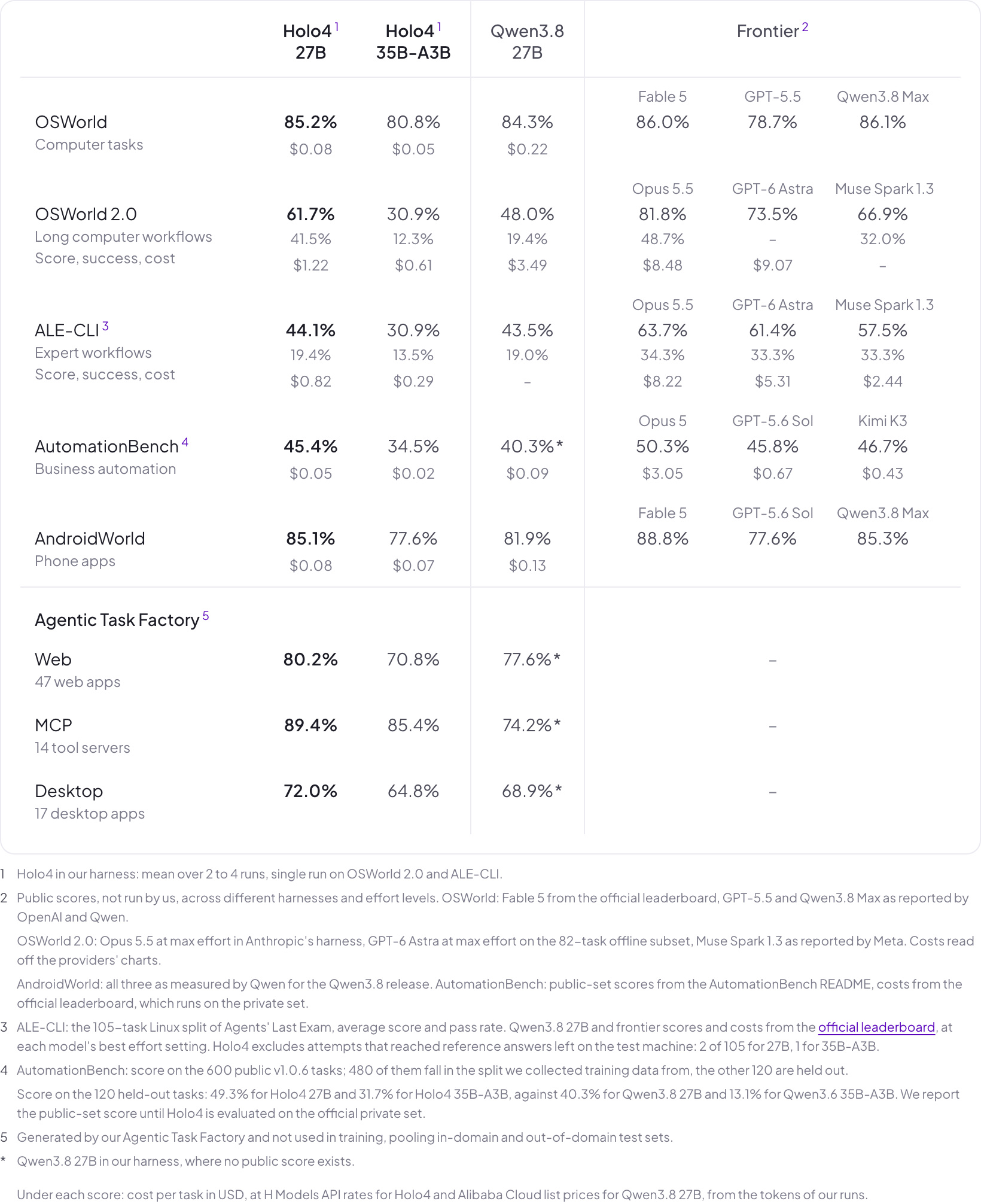
Image: huggingface.co
The company explicitly noted that test versions, task configurations, and execution environments differ from model to model. On AutomationBench, which measures how well a model uses business systems, Holo4 was evaluated in an internal environment. For some comparison models, the figures combine scores from public tasks with cost data from private ones. H company published the full task traces behind its public benchmark scores, and each step can be replayed or downloaded.
As examples of handling professional software, the company showed 3D modeling in FreeCAD and game development in Godot. It compared Holo4-27B against its base model, Qwen3.8 27B, using the same instructions and execution environment. In a case where the task was to build and run a Pac-Man-style game, Holo4-27B made 68 model calls while Qwen3.8 27B made 197. In building a model of the Eiffel Tower, though, the result flipped: 84 calls versus 60.
Where and how you can use it
Both Holo4 models are available as of launch day through the H Models API, meaning developers can plug them into their own services. Model files for users who want to run them locally have also been posted to Hugging Face in several formats. Holotron4 Nano, released alongside them, was developed by further training NVIDIA’s Nemotron 3 Nano Omni model. The company says it outperforms its base model on screen operation and external tool use tasks.
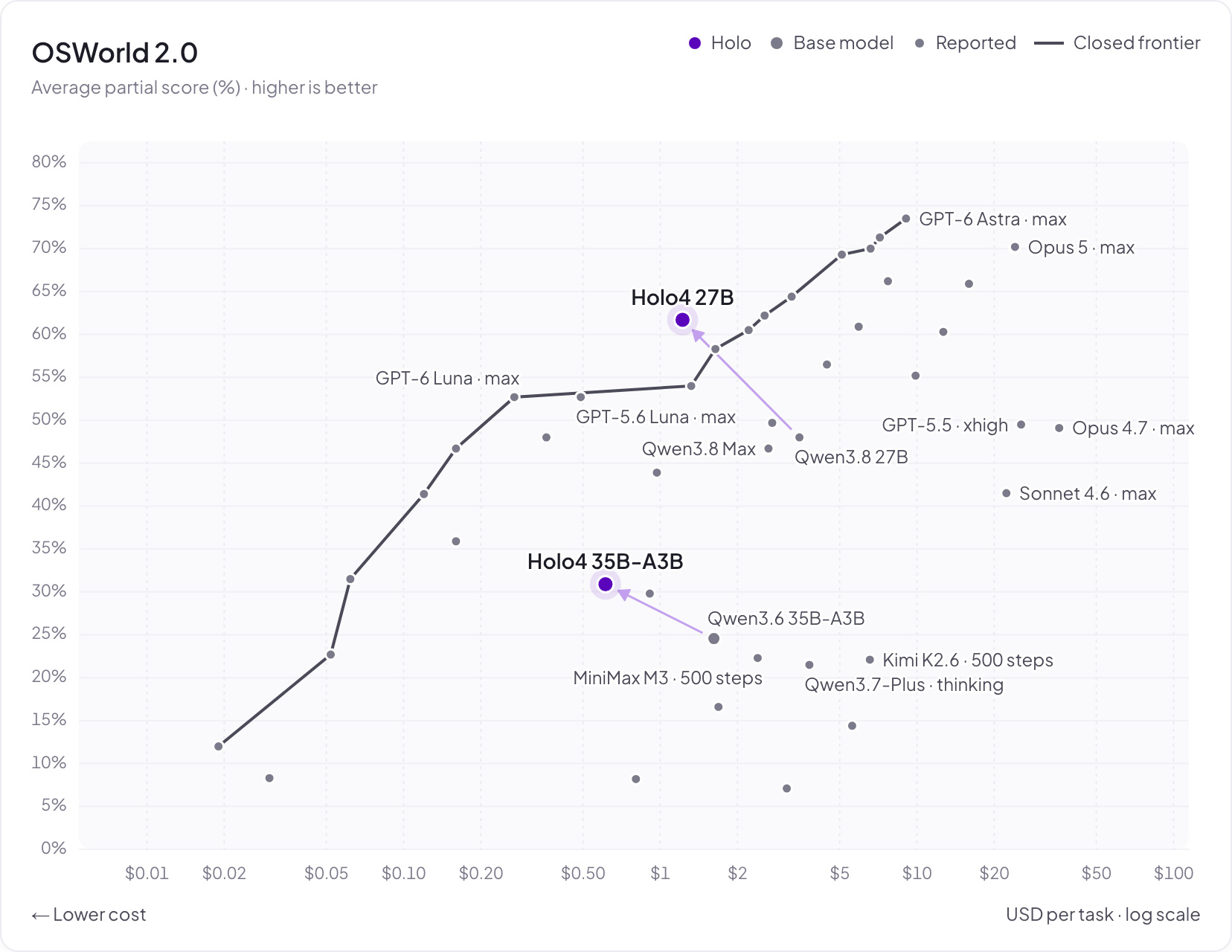
Image: huggingface.co
The execution framework was also reworked to sustain longer jobs. The company said it improved the model’s ability to remember work spanning hundreds of steps and enabled it to run commands directly on a desktop. An internal system that generates training tasks produced roughly 10,000 exercises across web apps, desktop environments, and more, including setups where screen operation and tool connections share the same task state.
H company said it plans to release DSpark, a companion model that further speeds up response generation, within days. What users should weigh is the success rate and cost for the specific work they intend to hand off, and the published task traces offer a way to check that.