Claude Opus 5.5 Answers 30% Faster and Costs Less
Anthropic has released a model that decides for itself how much thinking each task needs, and you can call it straight from the dev tools you already use. What remains to be seen is whether costs really fall in day-to-day work and whether the output holds up.
Anthropic unveiled Claude Opus 5.5, the first model in the Claude 5.5 family, on September 22 local time. The company says it performs comparably to Claude Fable 5.1 on most tasks. The heart of the change is efficiency on long-running work. Anthropic estimates that, at default settings, the model processes less text than its predecessor on common coding and agentic tasks (where the AI handles the work on its own). Depending on the task, it can also process more. The company also says responses arrive faster.
A 30% speed gain, and what that actually covers
Claude Opus 5.5 adjusts how much effort it puts into thinking based on the task at hand. That behavior cannot be switched off entirely, however. Anthropic says the model generates answers more than 30% faster than Opus 5. That figure refers to the speed at which output arrives. How quickly a single long task runs from start to finish is something you will need to measure separately in real use.
The company’s own benchmarks also show gains over the previous model. On Terminal-Bench 4.0 it scored 66.4%, 14.1 percentage points above Opus 5’s 52.3%. Its GDPval-AA v2.1 score rose from 1708 to 1846 Elo. All of these results were obtained under the conditions stated in the announcement. When applying the model to your own work, it is worth assessing for yourself, alongside these scores, how well it completes the specific tasks you plan to hand off.
A 40% cost cut, but will your bill drop that much?
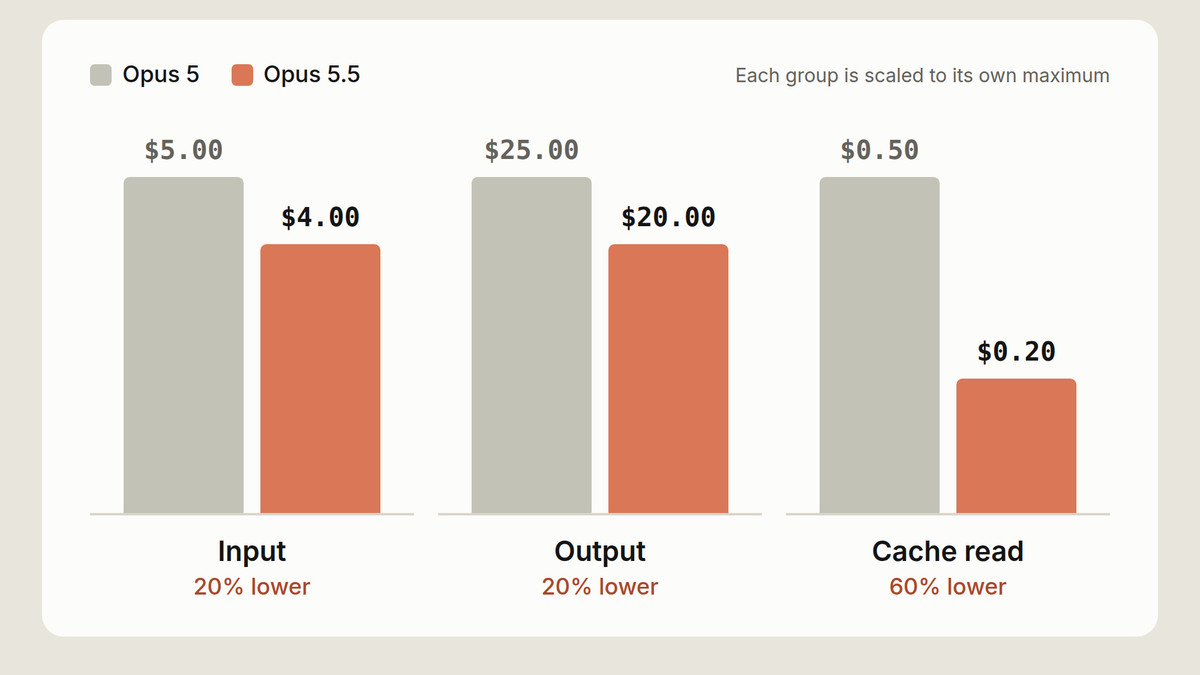
Anthropic estimates that the total cost of a typical task is roughly 40% lower than with Opus 5. The price list itself came down too. Input and output pricing is 20% cheaper than Opus 5, and reading back stored input costs 60% less. Note, though, that the 40% is not a rate cut. It is an estimate that combines the lower prices with the effect of the model processing less text.
For developers plugging the model into their own services, the base rate is $4 per 1 million input tokens and $20 per 1 million output tokens. A token is a small chunk of text, the unit used for billing. Reading back stored input costs $0.20 per 1 million tokens. Fast mode, which boosts speed by up to 2.5x, runs $8 per 1 million input tokens and $40 per 1 million output tokens. You can weigh speed against cost and pick accordingly.
Where you can use it right away
Work has also continued on making the new model available directly in the tools people already use. Anthropic’s coding tool Claude Code adopts Claude Opus 5.5 as its default Opus model in its new version. Third-party tools such as LangChain, a tool for building AI apps, have also added information about the new model.
It is available from launch on Claude’s Pro, Max, Team, and Enterprise plans. Beyond the Claude Platform and developer integrations, it is being supplied through Amazon Web Services (AWS), Google Cloud, and Microsoft Azure. AWS separately noted that it is available on Amazon Bedrock and on the Claude Platform running on its own cloud. In effect, that gives users more ways to access the model, through both the consumer app and enterprise cloud.
So can you trust it for real work?
Higher scores do not mean better results for every use. The Decoder, citing an explanation from an Anthropic employee, reported that optimization for technical tasks can make human-facing prose excessively dense. The Korean outlet AI Times, in a how-to piece, stressed writing clear goals and completion criteria into your prompt, the instruction you give the AI. In other words, look not only at the scores but also at whether the output is readable and whether you gave proper instructions.
There are limits on scope, too. Most cybersecurity tasks are routed to Opus 4.8. Broad access for life sciences research requires a separate application from verified institutions. Anthropic has said that pre-release evaluations alone cannot catch every failure that occurs in real-world environments. The significance of this release lies in the attempt to improve long-task performance, speed, and cost all at once. For users in Korea, the points to watch going forward are output quality on Korean-language work and the actual cost per task.